
Board pack: how to prepare a monthly board pack directors will read
How to prepare a monthly board pack: actuals against budget and last year, explained variances, cash runway, KPIs and the decisions the board must make.
Free app. Runs on your Mac with the Claude or Codex plan you already have.
What a board pack is
A board pack is the set of documents directors receive before a board meeting: the numbers for the period, what they mean, and the decisions the board is asked to make. In the US it is also called a board package or board deck. A monthly board pack is short: the main figures against budget and last year, the reasons for the differences, cash, and the risks ahead. Larger boards often receive a fuller pack each quarter; the monthly version keeps them informed in between.
Good board reporting lets a director understand the month in a few minutes and spend the meeting on decisions. The method below is how a finance lead or CFO prepares the monthly pack. Each step says what to do and why, then how 10folds carries it out. The pack is also a record: over a year, the monthly packs show how the company performed against what it told its board.
What it does for the business
- Better decisions in the meetingWhen directors arrive already knowing the numbers, the meeting is spent on choices instead of reading tables aloud. The finance team spends the meeting answering real questions instead of explaining the format.
- Problems raised earlyA pack that shows variances and cash runway every month surfaces a slipping plan while there is still time to change course. Directors can bring advice or contacts while the problem is still small.
- Trust in the numbersFigures that tie to the accounts, with their source shown, keep the discussion on what to do about them. When a figure is questioned, its source can be shown at once.
- Less work for the finance teamA fixed structure filled from the same sources each month takes far less effort than a new deck every time. Each month, only the numbers and the commentary need to change.
Board pack, step by step
Start from closed numbers
A board pack built on an open month will be corrected in front of the board.
What to do
- Close the month first: bank reconciled, accruals recorded, management accounts reviewed.
- Pull revenue, costs, cash and overdue invoices from the accounting system.
- Pull the budget for the same month and the actual figures for the same month last year.
- Pull operating figures from their own source: pipeline from the CRM, headcount from HR.
Why
Directors compare each pack with the last one. Numbers that change after the meeting damage trust in every pack that follows. It also means the board pack and the accounts tell the same story, which matters when an auditor or investor reads both.
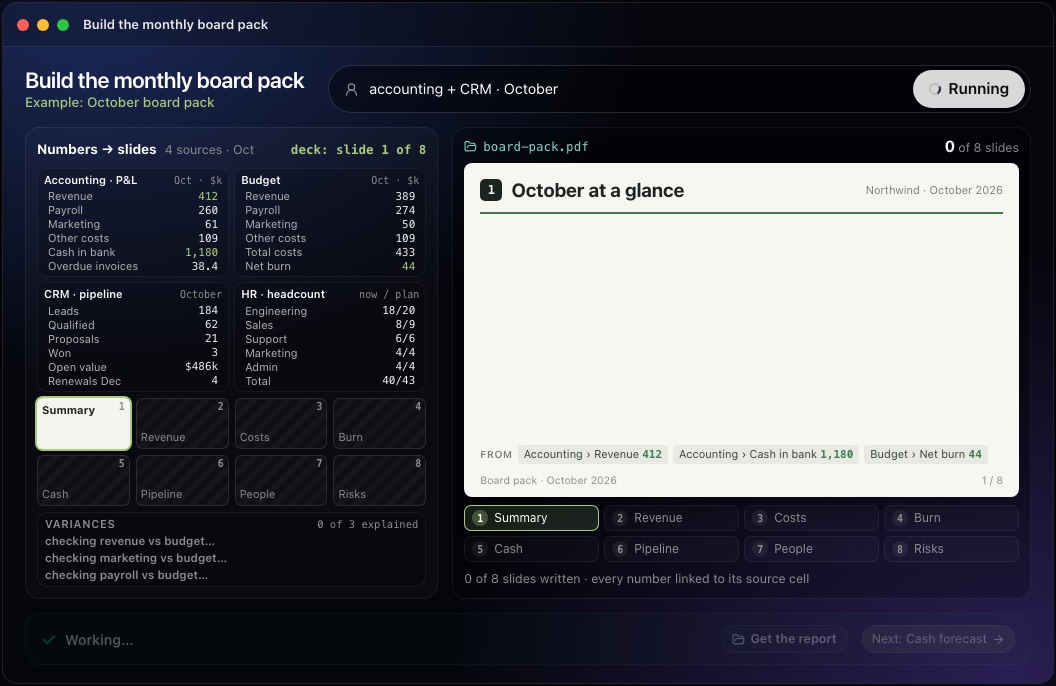
This step in the 10folds window. Example data from the animation on the home page. Compare with budget and last year
A number next to the plan tells a director where to look.
What to do
- Put each key line next to budget and last year, with the difference in amount and in percent.
- Choose a few KPIs that suit the business, and keep the same ones every month.
- Calculate cash runway: cash in the bank divided by average monthly net burn, and state the months used.
- Set a threshold for what counts as a large variance.
Why
Budget vs actual shows whether the plan is on track, and last year shows the trend without the plan's assumptions. A threshold keeps the commentary on what matters. Keep the same KPIs each month even when one looks bad; changing them when results dip is a quick way to lose a board's trust.
Explain the variances
Every large variance needs a cause, and the cause needs a name.
What to do
- For each variance over the threshold, find the cause in the transactions: a new customer, a delayed hire, a one-off cost.
- Say whether it is a timing difference, a one-off or a lasting change.
- Write one or two sentences per variance, with the figure.
- Ask the budget owner when the cause is not clear from the data.
Why
Variance analysis is the part directors read most closely. Saying marketing was over budget leaves them guessing; saying a one-off trade show caused it tells them whether to worry. A variance that repeats month after month is a sign the budget needs revising, and the pack should say so.
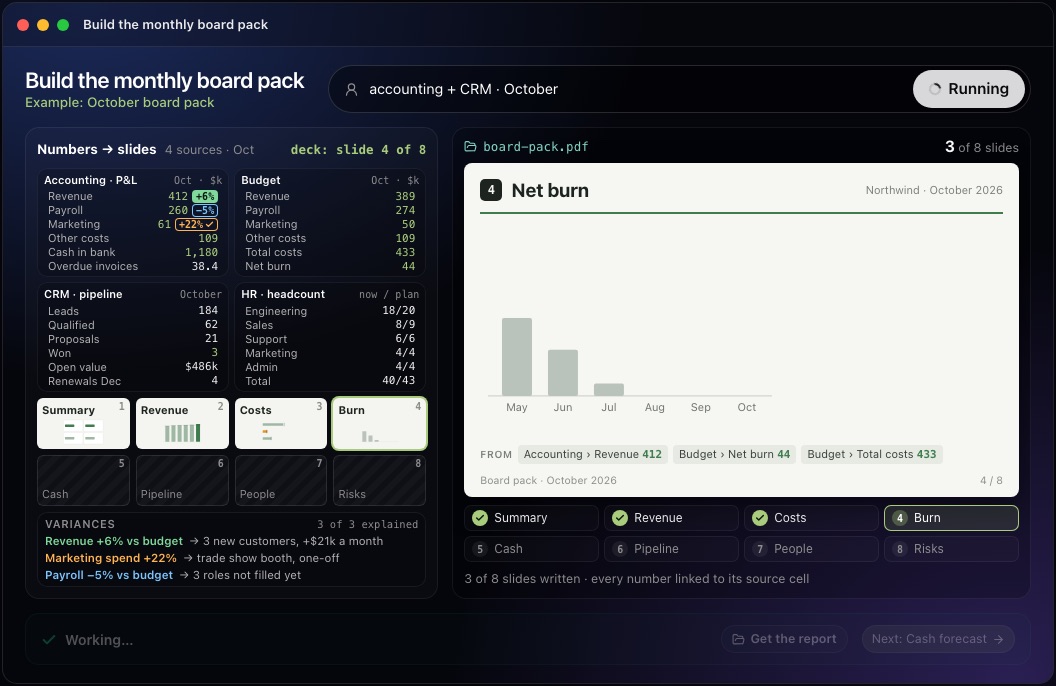
This step in the 10folds window. Example data from the animation on the home page. Add cash, risks and the outlook
A board pack that only looks back keeps the meeting in the past.
What to do
- Show cash at month end alongside runway, and note anything that will change it soon, such as a large payment.
- List the main risks, each with an owner and what is being done about it.
- Give a short outlook: the forecast for the quarter and what could change it.
- Include headline operating figures, such as pipeline and headcount against plan.
Why
Directors are responsible for the company's future as well as its past. Cash and runway show how long the plan can run, risks show what could stop it, and the outlook tells directors where their attention is needed next. Keep each risk to a line or two and put the detail in the appendix.
Write the pack around the decisions
Directors should know what is asked of them by the end of the first page.
What to do
- Open with an executive summary: the month in three or four sentences, the main figures and the decisions needed.
- Follow with sections in a fixed order, such as revenue, costs, cash, pipeline, people and risks.
- Use one chart per point, labeled with its source.
- Put detailed tables in an appendix.
- Have a second person check every number against the accounts before the pack is sent.
Why
Directors read the first page closely and skim the rest. A fixed order lets them compare months quickly, and an appendix answers detailed questions without crowding the summary. Each chart should make one point, with a title that states it, such as revenue ahead of budget for the third month running. Put a short glossary in the appendix if the pack uses terms some directors may not know.
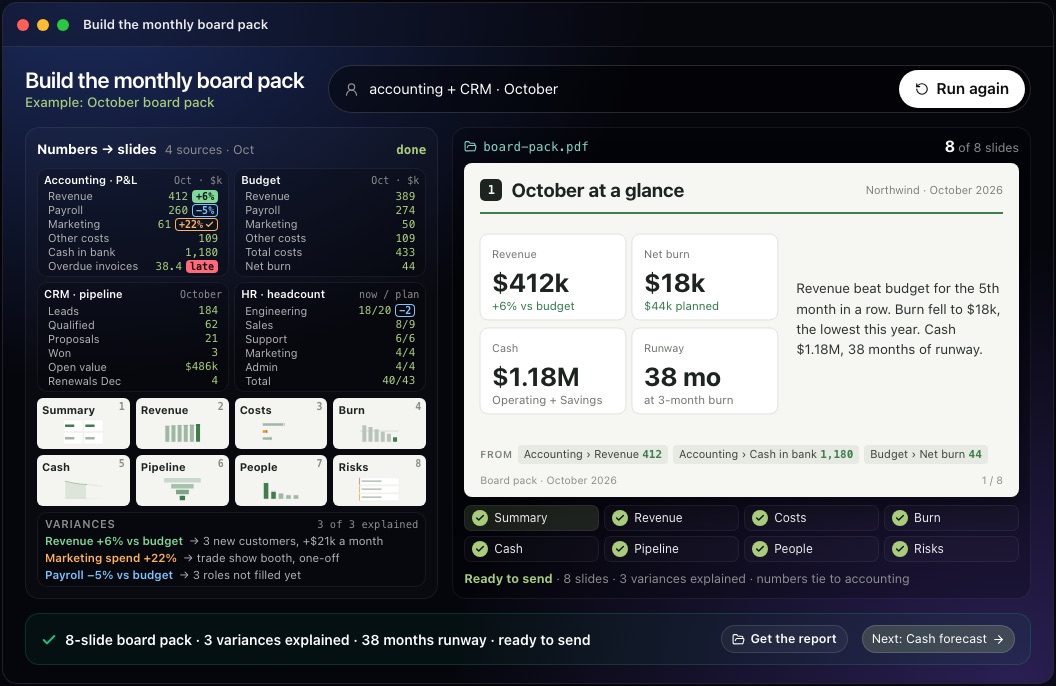
This step in the 10folds window. Example data from the animation on the home page. Send it early and follow up
A pack that arrives the night before is a pack nobody has read.
What to do
- Send the pack several days before the meeting.
- Note the questions directors raise, and answer them in the minutes or in the next pack.
- Track the actions agreed, and report on them next month.
Why
Directors need time to read and prepare questions. Following up on agreed actions turns the pack into a record of what the board decided and whether it happened. Directors who have read the pack ask better questions, and the minutes become a clear record of what was decided.
Common mistakes
- Building on an open monthFigures change after the meeting and trust drops.
- Tables without commentaryDirectors need the cause of each variance as well as its size.
- Too many metricsA few KPIs kept the same each month are read; thirty are skimmed and none is followed.
- Changing the layout every monthDirectors cannot compare one pack with the last.
- No decision askedA pack that only reports wastes the board's time, so ask for the decision you need.
What a good result looks like
- An executive summary with the main figures and the decisions needed.
- Each key line shown against budget and last year.
- A one-sentence cause for every variance above the threshold.
- Cash, net burn and runway, with how runway was calculated.
- Every number traceable to the accounts or the CRM.
And then what? Using the result
- Check every figure against the accounts before sending.
- Add the decisions you need from the board to the summary, each with a recommendation.
- Send the pack several days before the meeting.
- Record the questions asked and the actions agreed.
- Reuse the same structure next month.
When to run it
- Every month, after the closeA regular pack keeps directors informed between meetings and makes each meeting shorter. Directors see trends month by month instead of all at once each quarter.
- Before a funding round or a bank reviewThe same figures and commentary answer what investors and lenders ask first. Investors often ask for recent board packs during due diligence.
- When results move away from the planExplained variances show whether the gap is timing, a one-off or a trend. The board can then decide whether to revise the plan or hold its course.
- Before a strategy discussionA clear view of current results and cash gives the board a shared starting point for decisions about the next year.
Questions people ask
What is a board pack?
A board pack is the set of documents sent to directors before a board meeting: financial results, commentary, risks and the decisions the board is asked to make. It is prepared by the finance team or the company secretary and sent ahead of the meeting.
What should a monthly board pack include?
An executive summary, revenue and costs against budget and last year, explained variances, cash and runway, a few KPIs, pipeline, people, risks and the decisions needed. Detailed tables go in an appendix. Keep the same sections each month so directors can compare.
How long should a board pack be?
As short as the decisions allow. A monthly pack often fits in a handful of pages or slides, with the detail in an appendix. Longer packs tend to be skimmed, so put the detail where readers can find it if they need it.
When should the board pack be sent to directors?
Several days before the meeting, so directors have time to read it and prepare their questions. A pack sent late often means the meeting is spent reading instead of deciding.
What is the difference between a board pack and management accounts?
Management accounts are the full internal financial statements for the period, prepared for the people running the business. A board pack draws on them but adds what directors need: an executive summary, explained variances, risks and the decisions asked of the board.
Can the pack go straight to the board?
It should be reviewed first. Treat it as a draft for the finance lead to check against the accounts and approve. Nothing is posted to your books. Directors rely on it, so a person should sign it off.
More jobs in Finance
Build the monthly board pack, on your own Mac.Free app. Runs on your Mac with the Claude or Codex plan you already have. Your files stay on your computer.
Download for Mac