
Competitor analysis: how to compare your business with rivals
How to do a competitor analysis: choose real rivals, read their sites, prices, reviews and ads, compare point by point and turn it into a battlecard.
Free app. Runs on your Mac with the Claude or Codex plan you already have.
What a competitor analysis is
A competitor analysis is a side-by-side study of the businesses your customers could choose instead of you: what they offer, what they charge, what customers say about them and how they sell. Its purpose is practical. It should tell you where you win, where you lose and what to say when a customer names a rival. A long report that nobody opens after the meeting has missed that purpose. It belongs to every business, not only large ones: a local clinic needs to know what the practice down the road charges as much as a software company needs to know its rivals' features.
Most of the evidence is public: websites, price pages, customer reviews and ads. The skill lies in choosing the right rivals, comparing the same points for each and turning the result into a few decisions. The method below is how an experienced marketer or strategist builds one by hand. The same method works for a single location business or a company selling nationally; only the number of rivals and the sources change. Each step says what to do and why, then how 10folds carries it out.
What it does for the business
- Price and position with factsA pricing comparison and a list of what each rival includes let you set prices and offers from what the market really charges, not from impressions. It also shows which extras rivals include for free, so your price is compared like for like.
- Find the gaps rivals leave openReviews and offers often show needs no competitor serves well, such as weekend hours or clear pricing. Those market gaps are where a smaller business can stand out. Each gap comes with evidence from reviews or offers, so you can judge whether it is worth filling.
- Answer objections on the spotWhen a prospect says a rival is cheaper or faster, your team has a true, prepared answer instead of improvising. Honest answers, including where a rival is better, keep the conversation credible.
- See changes earlyRepeating the same comparison every quarter shows when a rival changes price, launches an offer or starts advertising heavily. A change spotted early leaves time to respond before customers start asking about it.
Competitor analysis, step by step
Set the question and choose the competitors
The competitors that matter are the ones your customers compare you with.
What to do
- Write the decision the analysis should inform: pricing, a new offer, sales answers or messaging.
- List direct and indirect competitors: the same service from others, and different ways to solve the same problem.
- Ask sales and customer-facing staff who comes up in conversations, and check who appears when you search for your main service.
- Keep four to eight rivals. A study of twenty is too thin to use.
Why
An analysis without a question collects everything and concludes nothing. And the businesses owners fear most are often not the ones customers actually weigh, which only real conversations and searches reveal. Including indirect competitors matters too, because customers often compare you with a different way of solving the problem, not only with a business like yours.
Read each competitor from public evidence
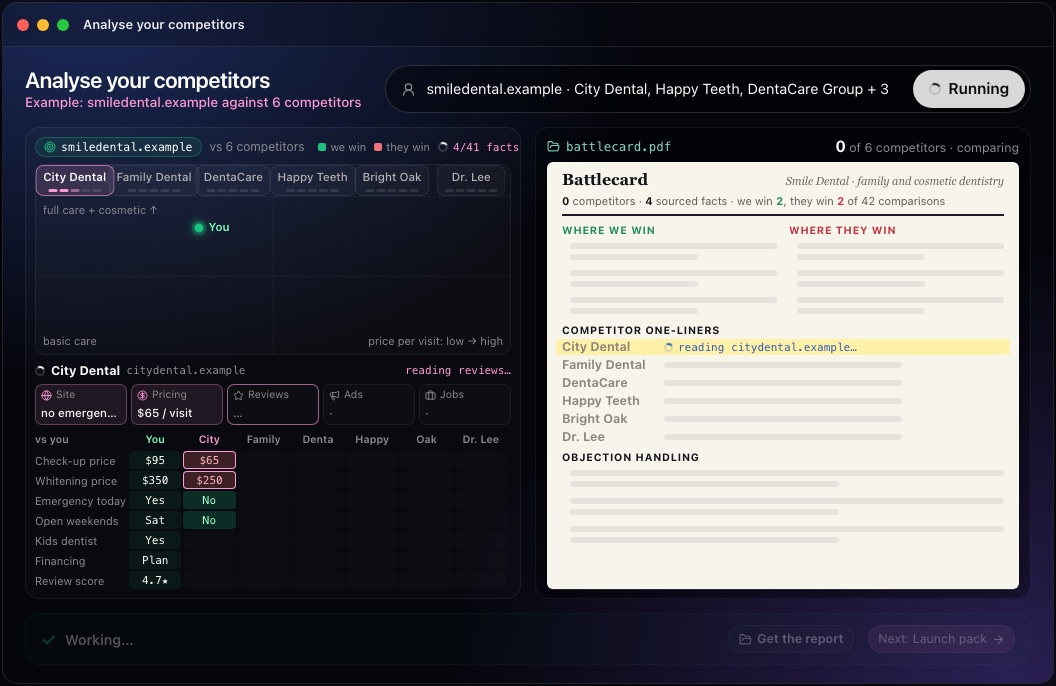
Write down where every fact came from, and when.
What to do
- Read each rival's site: services, who they target, hours, guarantees and how they ask for the sale.
- Record prices and what each price includes, with the date you saw it.
- Read customer reviews for repeated praise and complaints.
- Note their ads and offers: what they promote and to whom.
- Mark anything you could not find as unknown.
Why
Public pages, prices and reviews are the same evidence a customer sees when choosing. Dating each fact matters because prices and offers change, and an old figure presented as current misleads the team. Customer reviews deserve extra attention: they show what buyers care about in their own words, including problems a competitor's site will never mention.
This step in the 10folds window. Example data from the animation on the home page. Compare point by point
A comparison only works when every row asks the same question of everyone.
What to do
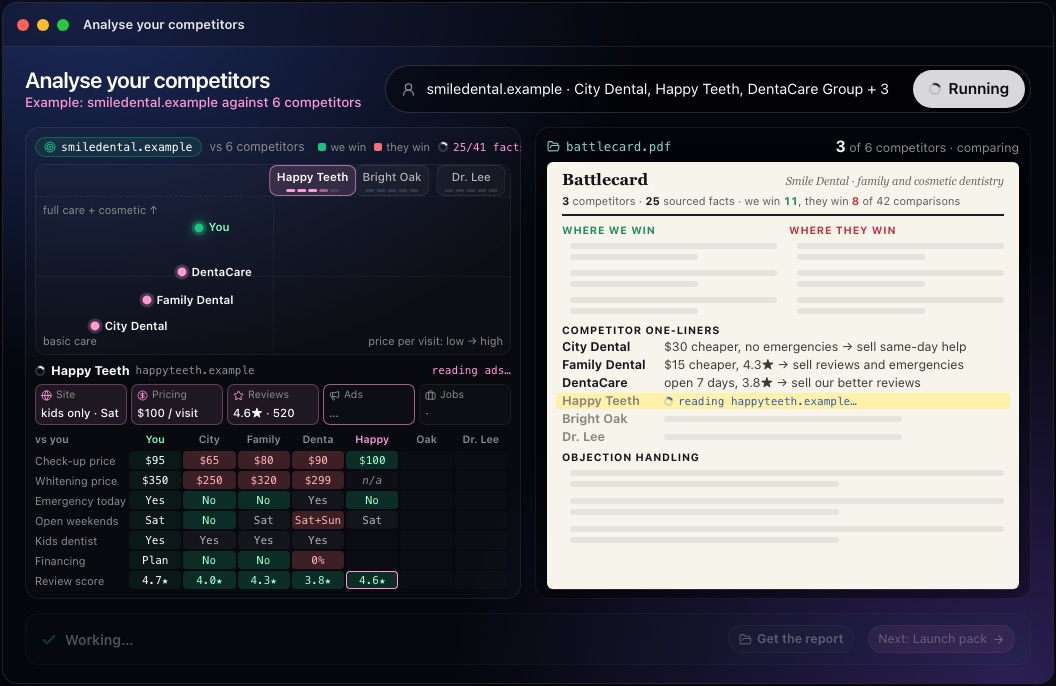
- Build one table: rows for each point that matters to customers, one column for you and one per rival.
- Include price, what is included, availability, specialties, financing or payment terms and review score.
- Mark each cell where you are ahead or behind.
- Place everyone on a simple map, such as price against breadth of service, to see the competitive landscape.
- Add a row for anything customers mention in reviews, even if it is not on anyone's site.
Why
Profiles written one by one hide the pattern. A single table makes it obvious where everyone looks the same and where one business stands apart. The map adds a second view. It shows at a glance whether the space you occupy is crowded or whether you stand alone.
This step in the 10folds window. Example data from the animation on the home page. Draw conclusions: strengths, weaknesses and gaps
Every finding should end in something you will do differently.
What to do
- Summarize where you win and where you lose, in plain sentences.
- Use a SWOT analysis if it helps: strengths, weaknesses, opportunities and threats.
- List the market gaps: needs customers mention that no rival meets well.
- Decide what to change: price, offer, message or nothing.
- Note one or two threats: a rival moving into your area or cutting prices.
Why
Data alone does not change anything. The value of the work is in the few decisions it supports, so the conclusions need to be explicit and short. Writing the conclusions as decisions also makes them easy to check later: you can see whether the price change or new message happened.
Write a battlecard for your team
If sales cannot use it on a call, the analysis is not finished.
What to do
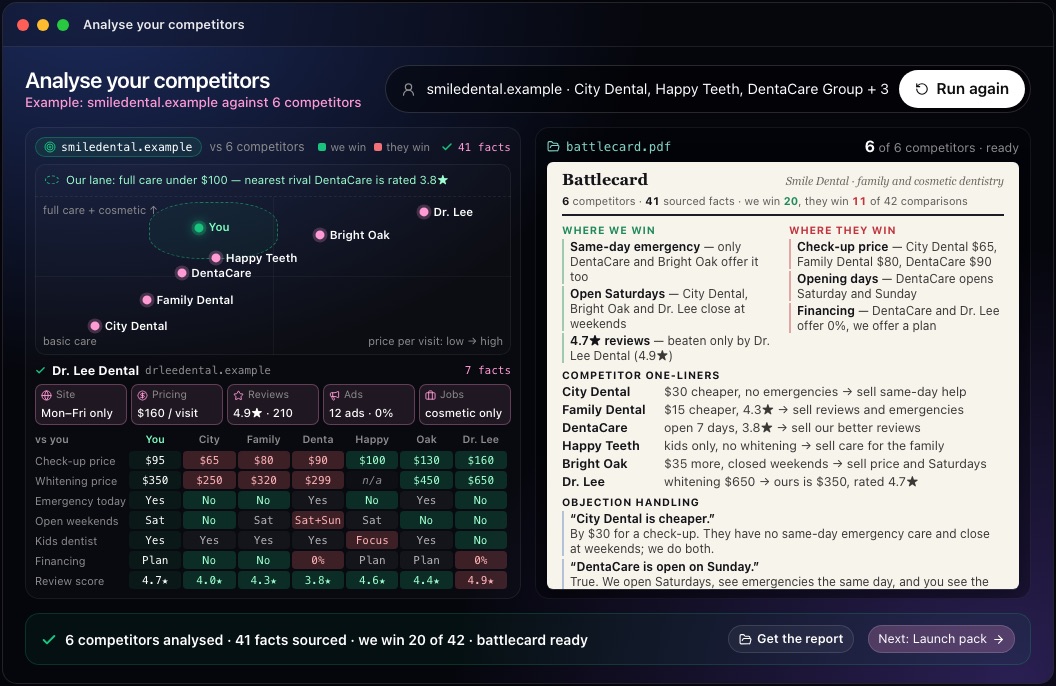
- Put it on one page: where you win, where they win, one line per competitor.
- Add objection handling: the claim a prospect repeats, and a short, true answer.
- Keep only facts with a source; drop anything you cannot defend.
- Date it and set a time to refresh it.
- Share a draft with sales and adjust the answers to what they hear on calls.
Why
A battlecard is the form of competitor analysis people actually use. One honest page beats a deck, and conceding where a rival is better makes the rest more credible. Refreshing it on a schedule matters as much as writing it, because an out-of-date battlecard gives sales confident answers that are no longer true.
This step in the 10folds window. Example data from the animation on the home page.
Common mistakes
- Choosing rivals from memoryCheck who customers mention and who appears in search.
- Undated pricesA figure from last year presented as current is wrong.
- Comparing different things for each rivalUse the same rows for everyone or the table means nothing.
- Hiding where you loseA battlecard that claims you win everywhere will not be trusted.
- Inferring strategy from one headlineReport what a competitor does, not what you guess it intends.
What a good result looks like
- A stated question the analysis answers.
- Four to eight real competitors, with why each was chosen.
- One comparison table, every fact sourced and dated.
- Clear lists of where you win, where you lose and the gaps.
- A one-page battlecard with objection handling.
And then what? Using the result
- Share the battlecard with everyone who talks to customers.
- Act on one gap: an offer, a price or a message change.
- Use the comparison to check your own landing page and ads.
- Repeat the analysis each quarter and note what changed.
- Give the comparison table to whoever writes your website and ads, so claims about rivals stay accurate.
When to run it
- Before setting or changing pricesA dated pricing comparison shows what customers will see next to your price. Keep it focused on the gap between your price and theirs, and on what each includes.
- When a new rival opens nearbyA focused comparison shows quickly where it is a threat and where it is not. Start with that one rival rather than redoing the whole study.
- When sales keep losing to the same nameThe battlecard gives the team a prepared, honest answer. Update the objection answers with what the team hears on calls.
- Before a new offer or campaignKnowing what rivals already promise helps you choose a claim nobody else makes. It also shows which promises would only make you sound like everyone else.
Questions people ask
How do you do a competitor analysis?
Set the question, choose the rivals customers really compare you with, read their sites, prices, reviews and ads, compare the same points for everyone, then write the conclusions and a battlecard. Keep the scope narrow enough that the result fits on one page for sales.
What should a competitor analysis include?
Who the competitors are and why, a point-by-point comparison with sources and dates, what customer reviews say, where you win and lose, the gaps in the market and actions to take. The most useful sections are the comparison table and the list of actions.
How do you identify your competitors?
Ask customers and sales who else they considered, search for your main service and note who appears, and include indirect competitors that solve the same problem differently. The rivals you lose deals to are the ones to study first.
How often should you do a competitor analysis?
A full one each year and a quick refresh of prices and offers each quarter, plus whenever a new rival appears or you change your own offer. Prices and offers move faster than positioning, so check those more often.
What is a battlecard?
A one-page summary for sales and support: where you win, where each rival wins and short answers to common objections. Keep it to one page so it is read before calls, and date it so people know how fresh it is.
What is the difference between direct and indirect competitors?
Direct competitors sell the same kind of product or service to the same customers. Indirect competitors solve the same problem a different way, such as software instead of a consultant, or doing the job in house. Include both, because a customer weighing a different kind of solution can still choose it over you.
More jobs in Marketing
Analyse your competitors, on your own Mac.Free app. Runs on your Mac with the Claude or Codex plan you already have. Your files stay on your computer.
Download for Mac