
Landing page audit: how to find what stops visitors acting
How to run a landing page audit: read the page as a visitor, score trust, offer and friction with evidence, and fix the few problems that matter most.
Free app. Runs on your Mac with the Claude or Codex plan you already have.
What a landing page audit is
A landing page audit is a structured review of one page built for one action, such as booking a visit, starting a trial or buying. It asks why a visitor who arrived interested would leave without acting, and what to change first. Done well, it ends with a handful of specific fixes tied to what was seen on the page. Done badly, it is a checklist of forty generic tips that nobody can rank.
The method below is how an experienced conversion specialist audits a page by hand. Conversion rate optimization (CRO) is the practice of increasing the share of visitors who take the page's action. Each step says what to do and why, then how 10folds carries it out.
What it does for the business
- More results from the same trafficAds and search already bring people to the page. Removing what stops them acting means more of those visitors become enquiries or customers, without buying more traffic.
- Know what to fix firstA ranked list of a few evidenced problems replaces debates about color and wording. The team starts with the change most likely to matter.
- A brief your designer can work fromExact before and after copy, with the location on the page, turns an opinion into a task someone can finish in an afternoon.
- Test with a clear questionAn audit that ends in one hypothesis and a defined measurement makes any later A/B test worth running. You know what you changed and what counts as success.
Landing page audit, step by step
Establish the visitor, the offer and the action
You cannot judge a page until you know who it is for and what it asks them to do.
What to do
- Write down who arrives, from which ad or link, and what they were promised.
- Name the actual offer and its price or conditions.
- Name the one primary action and the business step that follows it, such as a call back or a usable trial.
- Read the full page, including the footer, the form and any small print.
Why
A booking page, a trial page and a checkout page fail for different reasons. And an action is only useful if what happens next works: a form that sends enquiries to nobody is a broken page, however well it reads. Writing the context down first also lets anyone reading the audit see the assumptions behind each finding.
Read the page as a visitor, on a phone and a desktop
The page your visitor sees on a phone is the page you are really running.
What to do
- Look at what is above the fold, the first screen, on mobile and desktop.
- Check that the headline states the value proposition: what the visitor gets, in their words.
- Follow the call to action to its destination without submitting anything, and note where it leads.
- Note every point of form friction: fields, unclear labels, steps that feel like work.
- Measure speed only with a real tool; do not guess it.
Why
Most problems only show when you use the page the way a visitor does. Reading the source code cannot tell you whether the button is visible on a small screen or the form works. Recording the screen size and date with each observation means a later audit can compare like with like.
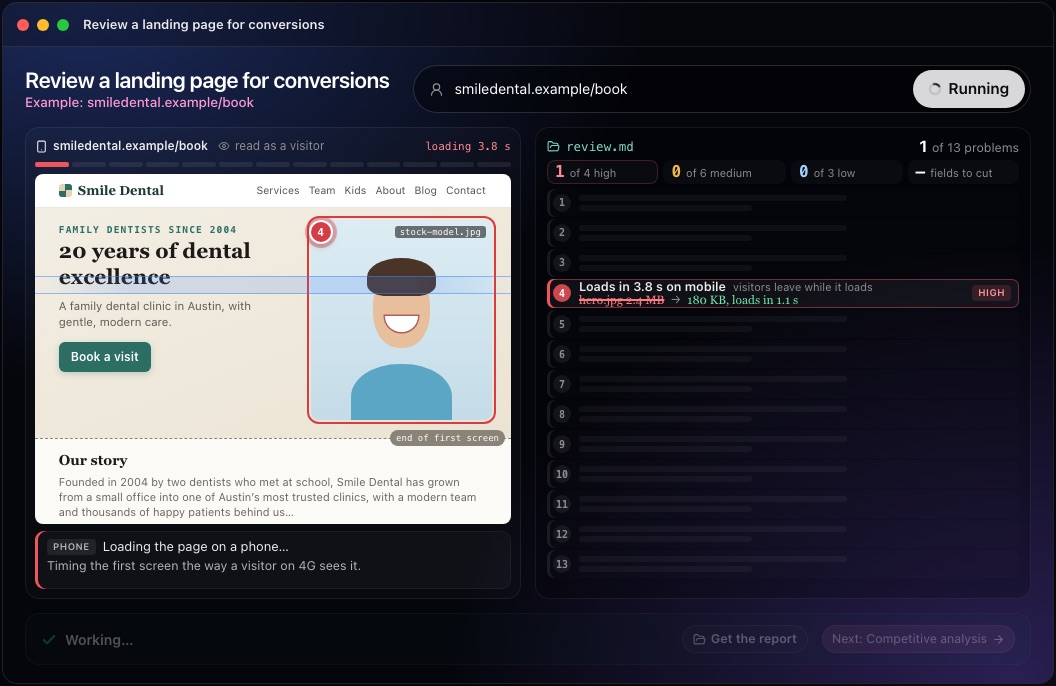
This step in the 10folds window. Example data from the animation on the home page. Assess trust, offer and friction with a fixed scorecard
A score is only as good as the evidence behind each line.
What to do
- Rate the same areas every time: offer and audience fit, trust, the journey to the action, friction, readability, mobile and access, and measurement.
- Under trust, check identity and contact, relevant social proof, clear costs and terms, and answers to the visitor's main worries.
- Tie every rating to something you saw. Mark what you could not check as unknown, never as a failure.
- Keep the weights fixed so two audits can be compared.
Why
Without a fixed frame, reviewers rate what they notice and skip what is hard. Separating unknown from bad stops a review from punishing a page for what the reviewer could not see. A fixed scorecard also makes a second audit after the changes a fair comparison with the first.
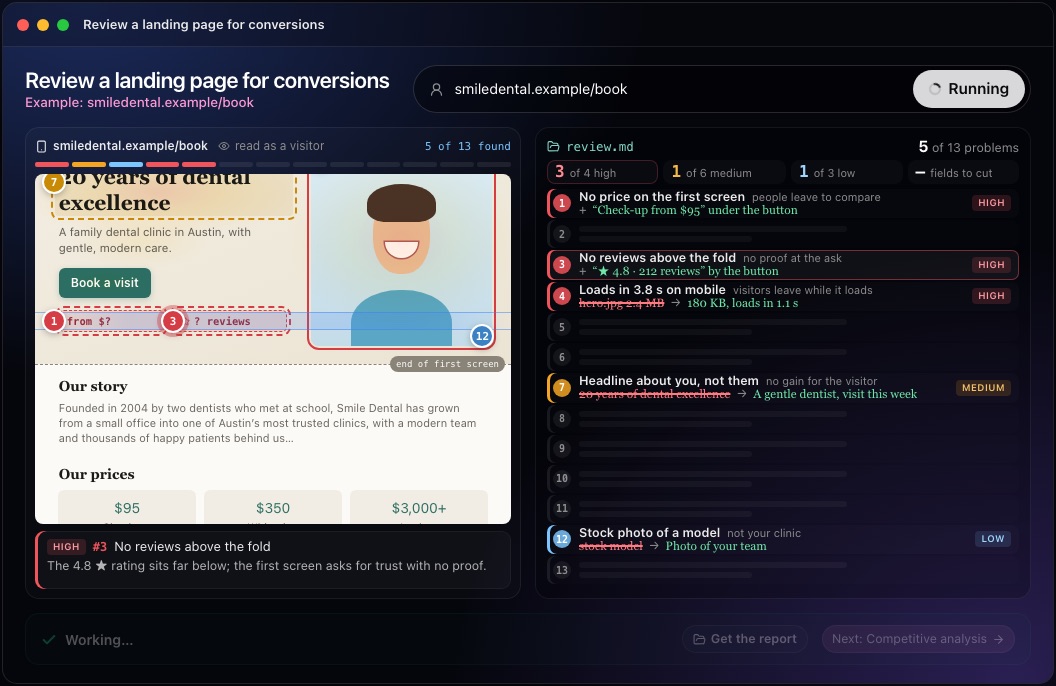
This step in the 10folds window. Example data from the animation on the home page. Choose the few fixes that matter and write the brief
Five fixes that get done beat thirteen that get filed.
What to do
- Rank problems by risk of misleading or blocking the visitor, then by value and by effort.
- For each fix, give the location, the current text or behavior, the proposed change and why it helps this visitor.
- Write exact before and after copy where words are the problem.
- Note what works well so nobody removes it.
Why
Teams act on short lists. A specific rewrite with a location is easy to approve; a general remark about clarity is not. Keeping strengths visible stops a redesign from breaking what already works. A short list also leaves room to act on the next round of findings once the first fixes are live.
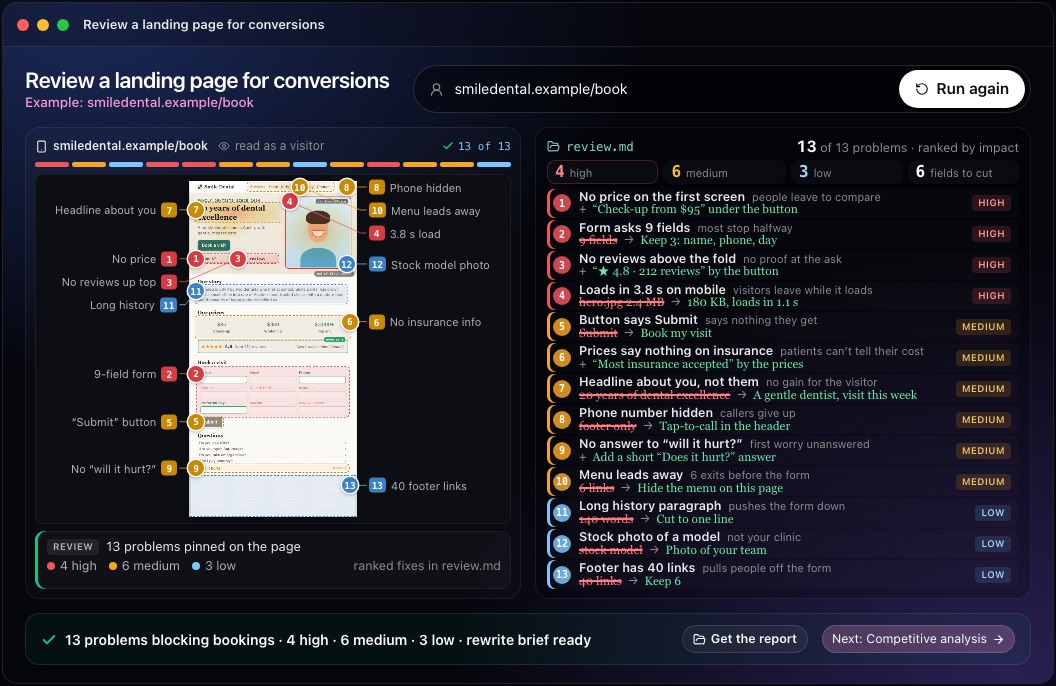
This step in the 10folds window. Example data from the animation on the home page. Define how to measure the change
Decide what success means before you change the page.
What to do
- Write one hypothesis for the most valuable change.
- Define the completed action that counts, such as a booking actually made, and a quality check on it.
- Check that the event is tracked before planning any A/B test.
- Do not size a test without a baseline and traffic figures.
Why
Many tests fail because nobody agreed what to measure or the event was never tracked. Getting the measurement right first is often the most useful next step for a small site. Without that groundwork, a test can run for weeks and still leave the question open.
Common mistakes
- Judging the page without its trafficA headline that fits one ad can be wrong for another.
- Reviewing only the desktop versionMany visitors arrive on a phone, where problems look different.
- Treating unknown as brokenWhat you could not check is a gap to close, not a defect.
- Asking for more form fields by defaultEvery extra field costs effort; add one only if it improves what happens next.
- Promising a conversion liftA fix is a hypothesis until it is measured.
What a good result looks like
- The audience, offer and primary action stated at the top.
- Every finding tied to a place on the page.
- Unknowns listed openly, separate from problems.
- Up to five ranked fixes with exact before and after text.
- One measurable next step, with what data is still missing.
And then what? Using the result
- Make the top fix first, especially if it removes a blocker.
- Give the rewrite brief to whoever edits the page.
- Set up tracking for the completed action before testing anything.
- Close the unknowns, such as a speed measurement, and run the audit again.
- Keep the strengths listed in the report when the page is redesigned.
When to run it
- Before spending on a campaignFixing the page first means the budget goes to visitors who can act.
- When traffic is steady but sign-ups are notThe audit shows what stops interested visitors at the page itself.
- Before briefing a designerA ranked, evidenced list keeps a redesign focused on the real problems.
- After changing the offer or priceCopy and proof written for the old offer often stop fitting the new one.
Questions people ask
How do you audit a landing page?
Start from the visitor, the offer and the one action, read the whole page on a phone and a desktop, rate trust, offer, friction and the journey with evidence, then pick the few fixes that matter most. The result should be a short list of fixes you can act on this week.
What should a landing page audit include?
The audience and action, findings tied to the page, a clear view of trust and social proof, form friction, mobile use, a short ranked list of fixes and a way to measure the result. Generic checklists can help you remember areas, but the findings must come from this page.
How often should you audit a landing page?
Before each major campaign and after any change to the offer, price or traffic source. A page that has not changed in months but whose ads have is also due. Run it again after you ship the fixes to confirm nothing new broke.
What makes a landing page convert?
A clear promise that matches what brought the visitor, proof that you are real and competent, honest costs and terms, little friction and one obvious call to action. Missing any one of these is usually enough to lose a visitor who was ready to act.
Does 10folds change my page or fill in my form?
No. It reads the page and follows the main button's destination without submitting anything, logging in or editing the live page. The result is a report and a brief. Your forms and analytics are left as they are.
Will it tell me how much my conversions will rise?
No. Each fix carries an impact hypothesis. It does not invent conversion rates, uplift or test sizes; it tells you what data you would need to measure them. That way any test you run later starts from real figures.
More jobs in Marketing
Review a landing page for conversions, on your own Mac.Free app. Runs on your Mac with the Claude or Codex plan you already have. Your files stay on your computer.
Download for Mac