
TikTok scraping: how to collect video data you can compare
TikTok scraping done responsibly: choose clear seeds, collect public video records with their links, keep unknowns empty and compare like with like.
Free app. Runs on your Mac with the Claude or Codex plan you already have.
What TikTok scraping is
TikTok scraping is the work of collecting public video records into a table: creator, caption, posting date, views, likes, comments, shares and the video link. Marketers use it to see which subjects and openings hold attention in their niche, and to find creators their buyers already watch. The value lies in a sample you can describe and check, because view counts on their own say little.
The method below is how a social media analyst does it by hand. Each step says what to do and why, then how 10folds carries it out and where its limits are.
What it does for the business
- Find the formats your audience watchesA table of recent videos in your niche shows which subjects and styles draw views and comments, so your own videos start from patterns that have already worked for someone.
- Spot creators worth partnering withCreators whose videos perform well for their size are often better partners than the largest accounts, and a fair comparison makes them visible.
- Track a competitor's short video activityRecording a competitor's recent videos shows what they promote, how often they post and how viewers respond.
- Give editors a concrete briefA shortlist of real videos, with links and numbers, tells an editor what to aim for faster than a written description.
TikTok scraping, step by step
Set the question and the seeds
Decide what you want to learn before TikTok decides what you see.
What to do
- Write the question, for example which kitchen remodel videos drew the most comments in the last 30 days.
- Choose the seeds: specific creators, specific videos, a hashtag or a sound.
- Fix the period and a cap on the number of videos.
- Note the country and language you care about.
Why
TikTok's feed and search results differ by viewer, country and time, so a scrape is always a sample. Seeds, a period and a cap make that sample repeatable. Without them, you cannot tell whether a change next month comes from the market or from what the scraper happened to see.
Pick a route that respects the platform
The rules of the platform are part of the brief.
What to do
- For your own account, use TikTok's built-in analytics or its official developer access.
- If you do academic or nonprofit research, check whether the TikTok Research API is open to you.
- For anything else, read TikTok's terms of service and robots.txt first.
- Go slowly, stop at sign-in pages and challenges, and collect public data only.
Why
TikTok's terms restrict automated collection and the platform blocks traffic that looks automated. Official routes are slower to set up and stable once running. Pages read without permission can change format overnight, and pushing past a block with logins or rotating identities breaks the platform's rules.
Collect video records with their links
Record what the page shows, when it showed it.
What to do
- Record creator, caption, hashtags, sound, posting date, views, likes, comments and shares where shown.
- Keep the video ID and link on every row, with the date you observed it.
- Record counts as displayed, and note when they are rounded, such as 1.2M.
- Leave out commenters and anything about private people. Under GDPR, comments and profiles are personal data.
Why
A video's numbers keep climbing for days, so a count without its observation date cannot be compared with another. The video ID lets anyone reopen the source. Downloading videos raises copyright questions and is rarely needed for research: the link is enough. Captions and hashtags are worth keeping in full, because they are often the only text that tells you what a video is about without watching it.
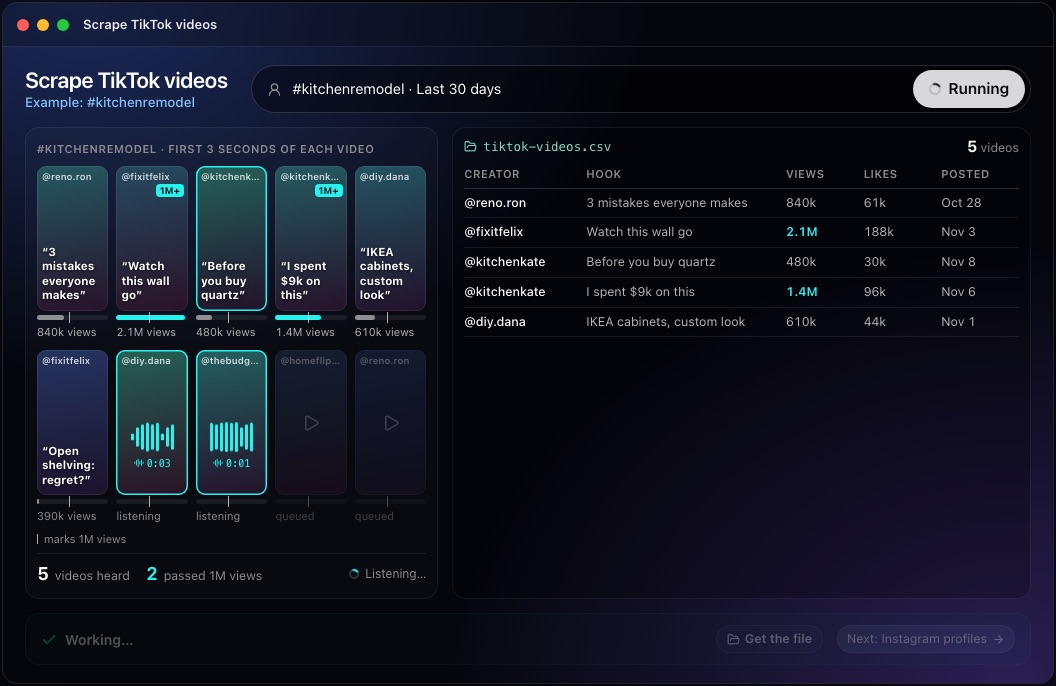
This step in the 10folds window. Example data from the animation on the home page. Check the records and name the gaps
A wall where you expected videos is a gap in your data, never an empty market.
What to do
- Open several rows and compare them with the live video.
- Remove duplicates by video ID.
- Keep missing metrics empty. Record zero only when the page shows zero.
- List every page that failed, with the reason.
- Convert rounded counts to numbers only after the check, and keep the original text beside them.
Why
A scraper that hits a sign-in page or a changed layout can return nothing, or return zeros, without raising an error. A short manual check and an honest list of failures stop a broken run from being read as a finding. Keeping the displayed text, such as 1.2M, next to the converted number also shows the reader how precise each figure really is.
Find the patterns, then watch the videos
The numbers tell you which videos to watch. Watching tells you why.
What to do
- Compare each video with the same creator's typical views, so small creators are judged fairly.
- If you calculate an engagement rate, state what you divided by: views or followers.
- Never add views, likes and shares into one score.
- Watch the top ten videos and note the first three seconds, the format and the call to action.
Why
A large creator's weakest video can outscore a small creator's best, so raw views mostly measure audience size. Engagement rate makes videos comparable when its formula is stated. What made a video work usually sits in the opening seconds, which only a person watching can judge. A trending sound or a paid boost can also lift a video for reasons that will not repeat, so look for the same pattern across several creators before you act on it.
Common mistakes
- Comparing videos of different agesA video posted yesterday has not finished collecting views.
- Ranking by raw views across creatorsJudge each video against its creator's usual results.
- Turning hidden or missing counts into zeroLeave them empty and say why.
- Downloading videos you do not ownKeep the link; the video belongs to its creator.
- Reading a blocked run as a quiet marketCheck the coverage before drawing any conclusion.
What a good result looks like
- A one-line description of the seeds, the period and the cap.
- One row per video, with its link, observation date and the counts shown.
- Empty cells for anything the page did not show.
- A list of pages that failed, with reasons.
- A short list of patterns, each with the videos that support it.
And then what? Using the result
- Script three test videos around the strongest pattern.
- Contact the creators who outperform their usual results.
- Share the shortlist of top videos with your editor.
- Repeat the run with the same seeds in a month and compare.
When to run it
- Before planning a batch of short videosRecent videos in your niche show which subjects and formats are worth testing first.
- When choosing creators for a campaignFair comparisons point to creators whose audiences respond, whatever their size.
- When a competitor starts posting oftenA table of their videos shows what they push and how viewers react.
- When a trend appears in your nicheComparing the videos that use it across several creators shows whether it lifts results widely or only for one account, before you spend time copying it.
Questions people ask
Is it legal to scrape TikTok?
It depends on your country, the data and the use. TikTok's terms restrict automated collection, and comments and profiles are personal data under laws such as GDPR. Collect public video data only, keep the minimum, and get advice before commercial use at scale.
What data can you scrape from TikTok?
From a public video page, usually the creator, caption, hashtags, sound, posting date and the view, like, comment and share counts. Watch time, reach and audience details are visible only to the creator.
How do you scrape TikTok without getting blocked?
Go slowly, request only what you need and stop at sign-in pages and challenges. The 10folds job does not rotate identities or bypass challenges; a blocked page is reported as a gap, and you can supply a saved copy of the public page instead.
Can a TikTok scraper download videos?
Some can, but downloading videos you do not own raises copyright questions. The 10folds job does not promise video downloads or transcripts. It records the video link and the public figures.
Does the TikTok scraping job search a hashtag by itself?
No. It reads the public video or profile URLs you supply, up to 25 per run and at most 100 records, and it does not claim full coverage of a hashtag or a search. Figures in the example screens on this site are illustrative.
Does it post or comment on TikTok?
No. It reads public pages and writes files in your project folder. It does not publish, comment or contact anyone.
More jobs in Scraping
Scrape TikTok videos, on your own Mac.Free app. Runs on your Mac with the Claude or Codex plan you already have. Your files stay on your computer.
Download for Mac