
13-week cash flow forecast: how to build one week by week
How to build a 13-week cash flow forecast with the direct method: start from bank cash, schedule receipts and payments, and find the week to watch.
Free app. Runs on your Mac with the Claude or Codex plan you already have.
What a 13-week cash flow forecast is
A 13-week cash flow forecast shows, week by week for the next quarter, how much cash will come in, how much will go out, and what will be left in the bank at the end of each week. It uses the direct method: expected receipts and payments with real dates, rather than a profit figure adjusted back to cash. Its purpose is to show the lowest week early enough to do something about it. Profit and cash differ because customers pay after they are invoiced, suppliers are paid on their own terms, and some costs, such as annual insurance, are paid in one week and used over a year.
Thirteen weeks is one quarter. It is short enough that most receipts and payments are already known from open invoices, bills and payroll, and long enough to see a shortfall coming while there is time to move a payment, chase a customer or arrange funding. The method below is how a finance lead or a turnaround adviser builds one by hand. Each step says what to do and why, then how 10folds carries it out. A spreadsheet is enough to start: one column per week, one line per type of receipt or payment, and a total row for cash at the end of each week.
What it does for the business
- See a shortfall weeks aheadA forecast that names the low week gives you time to act while the choices are still cheap. You can chase an invoice, delay a purchase or talk to the bank before the need becomes urgent. The earlier the warning, the more options you have.
- Time large paymentsKnowing which weeks are tight lets you place a tax payment, an annual renewal or an equipment purchase in a week that can absorb it.
- Give lenders and investors a straight answerBanks and investors ask how much cash the business will have and when. A weekly forecast built from real invoices and bills answers that with evidence they can check. It also shows them that someone in the business is watching cash closely.
- Run the business on cashA profitable month can still leave the account short if customers pay late. The weekly view shows liquidity directly, so decisions rest on the cash you will actually have.
13-week cash flow forecast, step by step
Start from the cash you have today
A forecast that starts from the wrong balance is wrong in every week that follows.
What to do
- Take the balance of every operating bank account on one date, from the bank itself.
- Reconcile it: list payments already sent but not yet cleared, and deposits not yet credited.
- Keep accounts in different currencies apart, or state the exchange rate you use.
- Note cash you cannot spend, such as a deposit held as security.
Why
The ledger can run days behind the bank, and uncleared checks or card settlements change what you can really spend. The opening balance is the one number every later week depends on. If you hold cash in several accounts, show each one and the total, so a shortfall in the account that pays salaries is not hidden by a surplus elsewhere.
Schedule the cash coming in
Customers pay when they pay, and the forecast should use the date they usually do.
What to do
- List every open customer invoice with its amount and due date.
- Move each one to the week that customer usually pays, using their payment history.
- Add expected receipts that are not invoiced yet, such as recurring contracts, only where they are reliable.
- Leave invoices in dispute out, or show them on a separate line.
- Include other cash receipts: tax refunds, loan drawdowns, asset sales.
Why
Due dates describe the contract and payment history describes behavior. A forecast built on due dates is optimistic in every week, and the error grows when cash is tight, because that is when customers stretch their payments. For a large customer, look at the last few invoices: if they always pay twenty days late, forecast twenty days late.
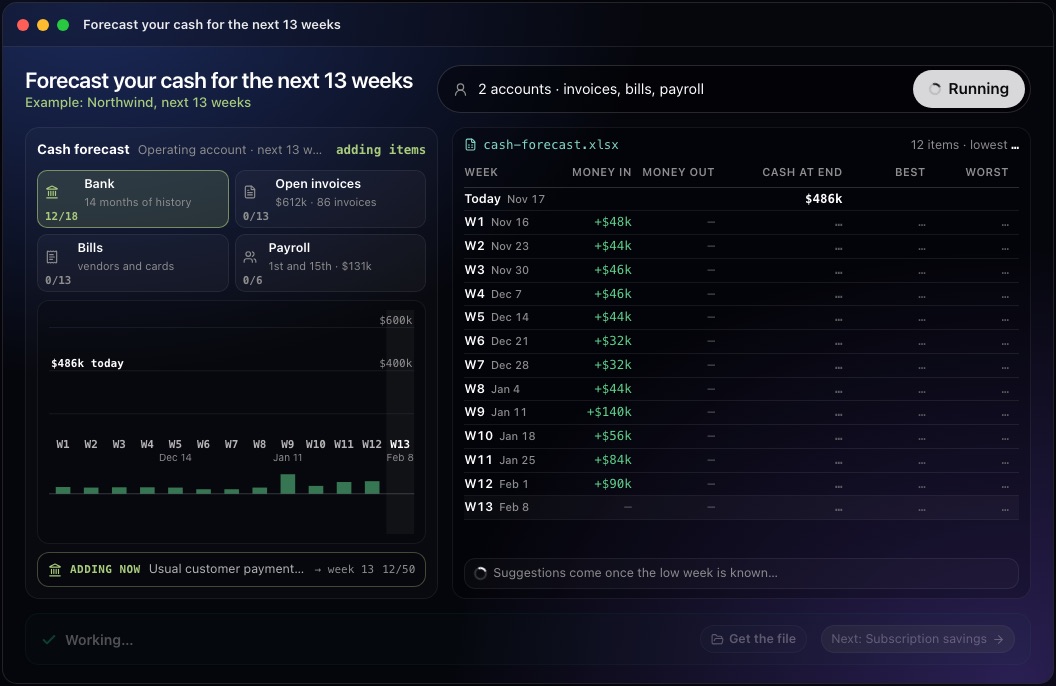
This step in the 10folds window. Example data from the animation on the home page. Schedule the cash going out
Keep the payments you control apart from the payments you cannot move.
What to do
- Put payroll in its exact weeks, with the taxes and benefits paid alongside it.
- List open supplier bills by the date you intend to pay them, and recurring costs such as rent, software and loan repayments.
- Add the large, irregular items: quarterly taxes, annual renewals, bonuses, equipment.
- Mark which cash disbursements can move and which cannot.
Why
Outflows are easier to predict than inflows, and they are where the forecast gives you choices. Knowing which payments are fixed and which can wait turns a warning into a plan. Payroll is usually the largest fixed outflow, and placing it in the wrong week can make a healthy forecast look like a crisis, or the reverse.
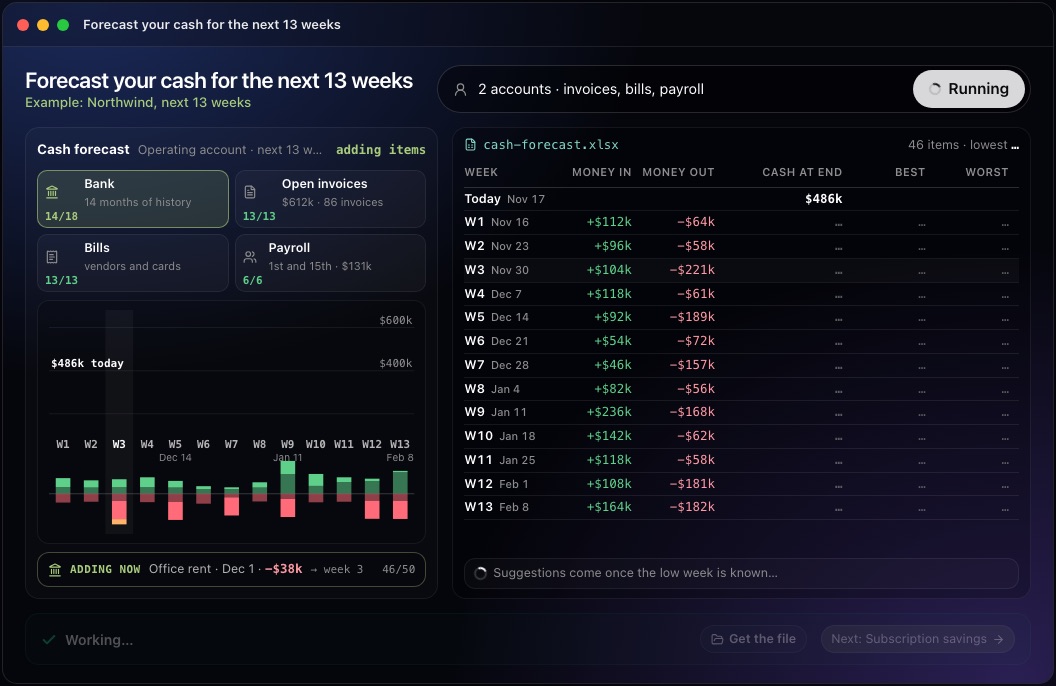
This step in the 10folds window. Example data from the animation on the home page. Find the low week and test the range
The number that matters most is the lowest one, and the week it falls in.
What to do
- Work out the ending cash balance for each week: opening cash plus receipts minus payments, carried into the next week.
- Set a minimum cash balance, the amount the business should never go below, and mark every week under it.
- Build a best case and a worst case, for example with your largest customers paying on time or a month late.
- For each tight week, list what could change it: a named invoice to chase, a named payment to move, a credit line to draw.
Why
A single line suggests more certainty than any forecast has. A range shows how bad things could get, and naming specific actions for the low week makes the forecast useful in a meeting. The worst case should be plausible, built from things that have happened before, such as your largest customer paying a month late.
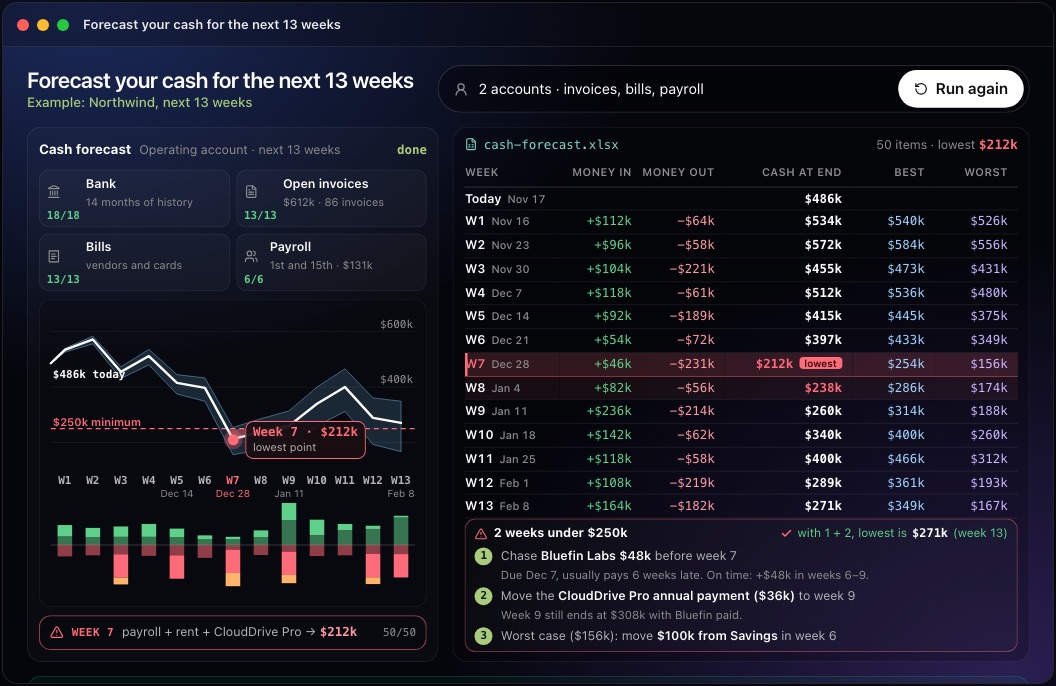
This step in the 10folds window. Example data from the animation on the home page. Roll it forward and check it against actuals
A forecast you never compare with the bank teaches you nothing.
What to do
- Each week, replace the week just ended with actual figures and add a new week 13.
- Run a variance analysis: compare actual receipts and payments with what you forecast for that week.
- Find the cause of each large gap: a customer slower than assumed, a missed bill, a timing error.
- Change the assumption behind the error, then update the numbers.
Why
A rolling forecast stays thirteen weeks long and gets more accurate each week, because its errors are found and fixed. Without the comparison, the same wrong assumption repeats every week. Over a few months, the comparison also shows which lines you forecast well and which deserve more caution.
Common mistakes
- Starting from the ledger balanceUncleared payments and deposits make the books differ from the bank, so start from the bank.
- Using due dates for receiptsCustomers who pay late every month will pay late in the forecast period too.
- Forgetting irregular paymentsQuarterly taxes, annual renewals and bonuses cause most of the surprises.
- Mixing profit with cashDepreciation and accruals do not move money; only receipts and payments belong in the forecast.
- Building it onceA forecast that is not rolled forward each week is out of date within a month.
What a good result looks like
- Thirteen weekly columns with opening cash, receipts, payments and ending cash.
- An opening balance tied to the bank on a stated date.
- The minimum cash balance, with every week below it clearly marked.
- A best and a worst case alongside the expected line.
- For each tight week, the specific invoices or payments that could change it.
And then what? Using the result
- Chase the invoices that decide the low week first.
- Move the payments you can move out of the tight weeks, and tell those suppliers early.
- If the worst case falls below your minimum, talk to your bank now.
- Share the forecast with your accountant or board, with the assumptions written down.
- Update it every week and keep last week's version to compare.
When to run it
- Every week, when cash is tightA weekly update shows whether the low week is getting better or worse while there is still time to act. If the lowest balance keeps falling week after week, act before it reaches your minimum.
- Before a large commitmentA hire, a big order or an annual contract changes cash for months. The forecast shows whether the business can carry it. Run the forecast with and without the commitment and compare the low weeks.
- Before talking to a lender or investorA 13-week view built from real invoices and bills is often the first thing they ask to see.
- When customers start paying laterSlower payments move cash out of the weeks you counted on. The forecast shows which week it hurts.
Questions people ask
What is a 13-week cash flow forecast?
It is a week-by-week projection of cash receipts, cash payments and the ending bank balance for the next quarter. It uses the direct method, so it works from expected payments with dates rather than from profit. Small businesses use it to manage tight months, and lenders and advisers rely on it when a company needs funding or is restructuring.
How do you build a 13-week cash flow forecast?
Start from today's reconciled bank balance, schedule expected receipts and payments into 13 weekly columns, and carry each week's ending cash into the next. Then mark the weeks below your minimum and test a best and a worst case.
Why use 13 weeks for a cash forecast?
Thirteen weeks is one quarter. Most receipts and payments in that window are already known, and it reaches far enough ahead to fix a shortfall before it arrives. Longer horizons are better served by a monthly forecast built from the budget.
How often should a 13-week cash flow forecast be updated?
Every week. Replace the week just ended with actuals, add a new week at the end, and compare what happened with what you forecast. Most of the value comes from that comparison, because it shows which assumptions were wrong.
What is the difference between the direct and indirect method?
The direct method lists actual receipts and payments with their dates. The indirect method starts from profit and adjusts for non-cash items and working capital. A 13-week forecast uses the direct method, because short-term cash depends on when money actually moves.
Does it move money or change my accounts?
No. The forecast is prepared for you to review and decide on. Nothing is posted to your books, and any payment you move is your decision.
More jobs in Finance
Forecast your cash for the next 13 weeks, on your own Mac.Free app. Runs on your Mac with the Claude or Codex plan you already have. Your files stay on your computer.
Download for Mac