
How to turn a trade show exhibitor list into a visit plan
Turn a trade show exhibitor list into a table you can work from: companies, booths, websites, speakers and the stands worth your visit.
Free app. Runs on your Mac with the Claude or Codex plan you already have.
What working from a trade show exhibitor list involves
A trade show exhibitor list is the set of companies taking a stand at an event, usually published by the organizer as an exhibitor directory on the event website. On its own it is a long page of names and booth numbers. The work is turning it into something you can act on: a table of companies with their websites, what each one does, where its stand is, who is speaking, and which stands deserve your limited time on the floor.
The method below is how an experienced event or sales planner does it by hand. Each step says what to do and why, then how 10folds carries it out.
What it does for the business
- Arrive with a plan instead of a mapA large show has more stands than anyone can visit. A ranked list with booth numbers lets you walk the floor in order and spend your hours on the stands that matter.
- Book meetings before the doors openKnowing who exhibits weeks ahead leaves time for pre-show outreach, so the busiest people have a slot for you before their calendar fills.
- Find companies in a niche quicklyAn event in your sector gathers suppliers, partners and competitors in one directory. The list is a fast way to see who is active in a market this year.
- Follow up with contextA table of who you planned to see, and why, makes follow-up after the event specific instead of generic.
Trade show exhibitor list, step by step
Set your goal and criteria
An exhibitor list is only useful once you know what you are looking for in it.
What to do
- Write why you are going: find customers, meet partners, scout suppliers, watch competitors.
- List the topics, products or categories that make an exhibitor relevant to you.
- Note your target accounts, so you can spot them in the directory at once.
- Decide how many stands you can realistically visit or meet.
Why
Without criteria every stand looks interesting and none gets prepared for. The topics you write here become the test you apply to every exhibitor.
Collect the exhibitor directory
The organizer's own directory is the source; every other list is a copy.
What to do
- Find the official exhibitor directory, floor plan and agenda pages on the event website.
- Capture each exhibitor's name, booth number, categories and description as the organizer shows them.
- Collect the speaker list from the agenda, with each speaker's company and talk title.
- Save the page address and the date you read it, since directories change up to the event.
- Respect the site: do not get around logins or anti-bot checks.
Why
Directories are updated as stands sell and companies withdraw. A dated copy tells you what was true when you planned. Speakers are often the most senior people at the show and the easiest to meet.
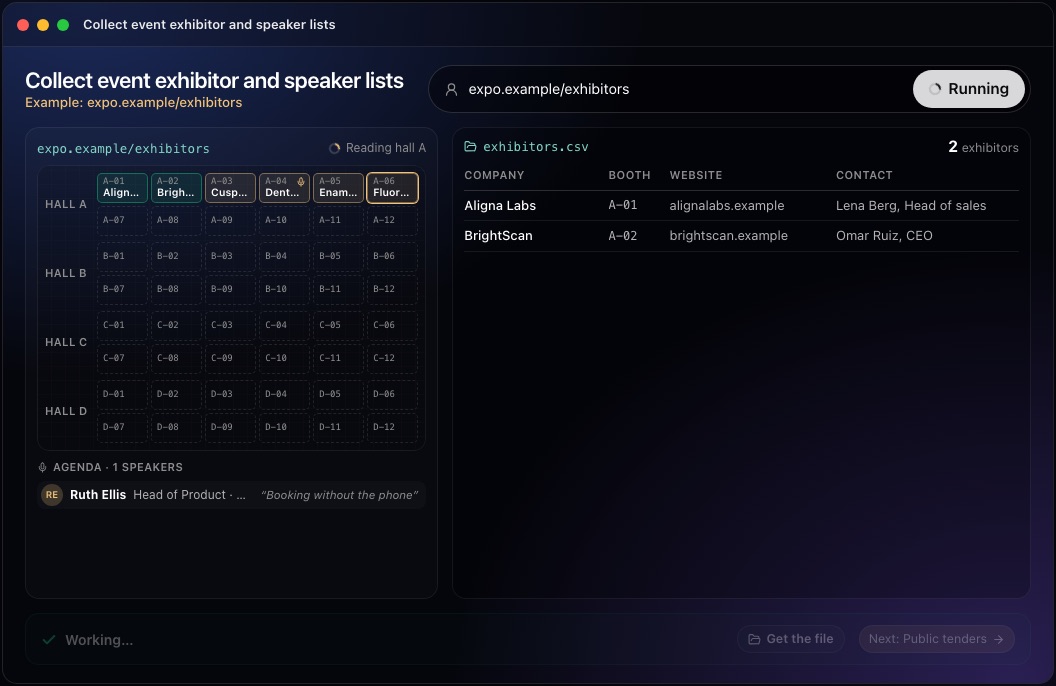
This step in the 10folds window. Example data from the animation on the home page. Identify each company
A booth name is not a company until you know its website.
What to do
- Find the official website of each exhibitor, checking that it matches the name and category in the directory.
- Note what each company sells in one line, in your own words.
- Mark exhibitors whose website you cannot confirm, instead of guessing, and check them at the stand.
- Match the list against your CRM to spot customers, open deals and target accounts.
Why
Exhibitor names are often trading names, abbreviations or local subsidiaries. The website domain tells you exactly which organization is behind the stand and lets you match it to your own records. It also stops you from preparing for the wrong company.
Rank the stands worth visiting
Every stand on your list should have a reason you could say out loud at the booth.
What to do
- Score each exhibitor against your topics and target accounts.
- Write a one-line reason to visit, tied to a topic or a need.
- Group the top stands by hall, so your route on the floor is short.
- Keep exhibitors you are unsure about in a separate group to check on the day.
Why
A ranked list with reasons turns the floor plan into a schedule. The reason to visit is also the opening line of the conversation when you get there. Grouping by hall saves walking time on a crowded floor.
Plan meetings and outreach within the rules
Permission to read a directory is not always permission to email from it.
What to do
- Read the organizer terms: some directories allow networking use only, not marketing.
- For pre-show outreach, write to routes the company publishes, and mention the event and the reason for your message.
- Remember that speaker names and named contacts are personal data in the EU and UK, and that unsolicited email rules differ by country, from an opt-out in the US to prior consent in some EU countries.
- Share the ranked table with your team before the event and agree who visits which stand.
Why
Most exhibitors expect visitors and welcome meetings. Mass emailing a scraped directory is another matter: it can breach the organizer's terms and data protection law. A short, relevant message to a published address respects both.
Common mistakes
- Arriving without a ranked listYou spend the day at the stands nearest the entrance.
- Working from an old copyDirectories change; plan from the latest official page and note its date.
- Guessing websites from namesTrading names mislead; confirm each company's site.
- Mass emailing every exhibitorRead the organizer terms and email rules, and write only where you have a reason.
- Ignoring the speakersThe agenda names senior people who are easy to approach after their talk, often more so than at their stand.
What a good result looks like
- Every row has the exhibitor's name, booth number and source page.
- Websites confirmed, or marked as not found.
- A priority and a one-line reason to visit for each relevant stand.
- Speakers listed with their company and talk.
- The date the directory was read, and which pages could not be reached.
And then what? Using the result
- Request meetings with your top stands a few weeks before the event.
- Plan your route by hall, starting with the highest priority stands.
- Add the speakers whose talks match your topics to your schedule.
- Load the table into your CRM after the event, with notes from each conversation.
- Run the collection again shortly before the show to catch late exhibitors.
When to run it
- Before a trade show you are visitingA ranked table with booth numbers turns a large floor into a short, planned route.
- When looking for companies in a nicheAn event directory is a current list of who is active in a sector, gathered by the organizer.
- Before booking meetings at an eventKnowing who exhibits and who speaks lets you write early, with a specific reason.
- When deciding whether to exhibit next yearThe list shows which competitors, partners and target accounts take a stand, which helps you judge whether the event reaches your market.
Questions people ask
How do I get a trade show exhibitor list?
Start with the event website: most organizers publish an exhibitor directory, often with a floor plan and booth numbers, weeks or months before the show. Some offer a downloadable list. Data vendors also sell lists, but the organizer's page is the source to check against.
Can I email trade show exhibitors?
Often, with care. Check whether the organizer terms allow marketing use of the directory, write to addresses the company publishes, and follow the email rules where the recipient is, which range from an opt-out requirement in the US to prior consent in some countries.
What is the difference between an exhibitor list and an attendee list?
An exhibitor list names the companies taking a stand and is usually public. An attendee list names the visitors and is normally private; organizers rarely share it, and lists offered for sale need careful checking under data protection rules.
How do I decide which booths to visit?
Score each exhibitor against the topics you care about and your target accounts, write one reason to visit for each, and group the top ones by hall. Keep a short list of maybes to check on the day.
How far ahead should I prepare for a trade show?
Start a few weeks before the event. That leaves time to rank the stands, request meetings before calendars fill and plan your route by hall. Check the directory again shortly before the show, since late exhibitors join and others withdraw.
Will 10folds contact exhibitors or book meetings?
No. The job reads public event pages and delivers a table. It does not send messages, book meetings or write to any site. Outreach stays your decision.
More jobs in Sales & outbound
Collect event exhibitor and speaker lists, on your own Mac.Free app. Runs on your Mac with the Claude or Codex plan you already have. Your files stay on your computer.
Download for Mac