
How to find B2B leads that fit, week after week
How to find B2B leads on the web: define who you sell to, search the right sources, check each company's own site and keep only those that fit.
Free app. Runs on your Mac with the Claude or Codex plan you already have.
What finding B2B leads involves
Knowing how to find B2B leads means having a repeatable way to discover companies that match who you sell to, confirm that each one fits, and record a way to reach it. A lead here is a company worth contacting. The hard part is keeping the list relevant: most companies that look right in a directory are the wrong size, sell to the wrong market or are already in your CRM.
This is the outbound side of lead generation, where you go looking for buyers instead of waiting for them to fill in a form. The method below is how a sales development rep does it by hand. Each step says what to do and why, then how 10folds carries it out.
What it does for the business
- Never run out of companies to contactProspecting stalls when the list runs dry and someone has to stop selling to research. A steady batch of new companies each week keeps outreach moving without that pause.
- Spend selling time on companies that fitEvery message to a company outside your market is wasted effort. Checking fit before a company reaches the list means the time spent writing to it has a reason behind it.
- Reach companies your competitors overlookMany good prospects do not appear in the large databases or map listings everyone buys from. Reading niche directories, event pages and news finds companies that receive fewer cold messages.
- Keep a clean history of who you foundA record of every company already delivered stops duplicates and repeated outreach. It also shows over time which sources produce companies that fit.
How to find B2B leads, step by step
Define who you sell to
A lead only counts if you would be glad to win it as a customer.
What to do
- Write your ideal customer profile: the type of company most likely to buy and stay.
- Set the firmographics, meaning measurable company facts: sector, country, size, business model.
- Add the evidence that shows fit on a website, for example a pricing page aimed at HR teams.
- List hard exclusions: markets you cannot serve, companies too small to pay, existing customers.
- Decide how many new companies you can work each week.
Why
Without a written profile, each researcher applies a different idea of fit and the list drifts. A weekly number keeps research in step with what the sales team can follow up.
Choose where to look
Search where your buyers show themselves, not only where everyone else searches.
What to do
- Pick sources that list companies of your type: industry directories, startup lists, event exhibitor pages, association member lists.
- Add sources of buying signals, such as funding news, job posts for a relevant role or a new product launch.
- Avoid relying on purchased contact lists. They are often out of date and shared with every competitor.
- Note each source, so you can see later which ones produce companies that fit.
Why
One large database gives every seller the same list. Niche sources find companies that are less contacted, and a buying signal suggests a reason to talk now.
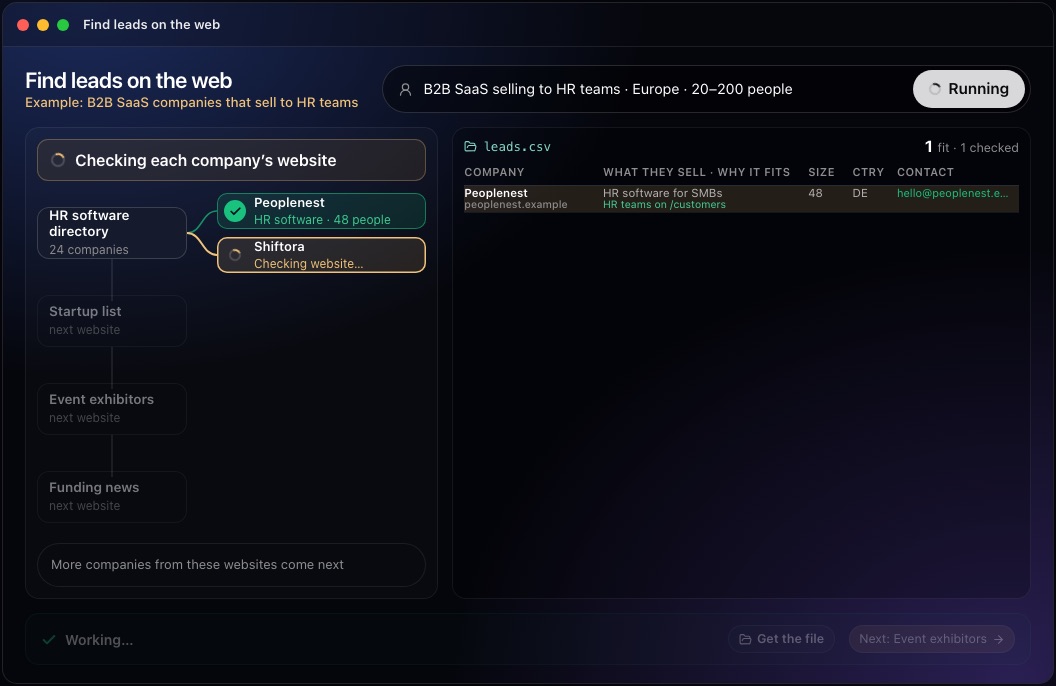
This step in the 10folds window. Example data from the animation on the home page. Check each company on its own website
A directory entry is a rumor until the company's own site confirms it.
What to do
- Open the company's home page, product or service pages and, if there is one, its customers page.
- Confirm what it sells, who it sells to, where it operates and its approximate size.
- Reject it with a short reason when it fails one condition: wrong market, consumer product, too small.
- Write one line on why it fits, citing the page that shows it.
Why
Directories and lists are often old or vague. The company's own site is the most current statement of what it does. A rejection reason also tells you whether a source is worth using again.
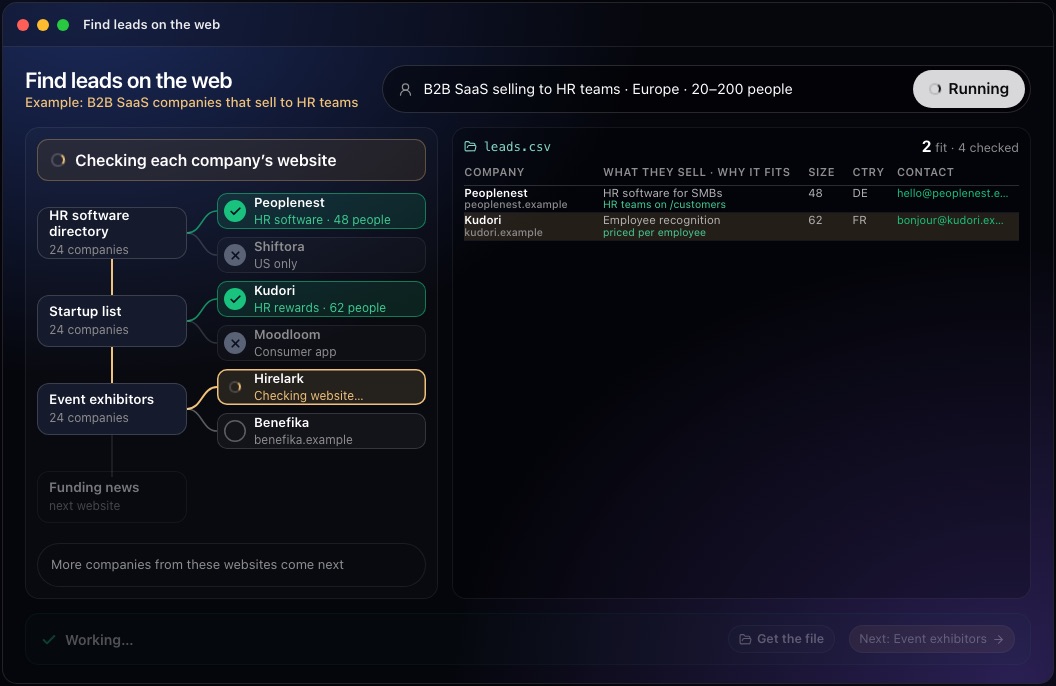
This step in the 10folds window. Example data from the animation on the home page. Find a contact route and respect the rules
A contact you are not allowed to use is not a lead.
What to do
- Prefer routes the company publishes for business enquiries: a contact address, a sales or partnerships address, a contact form.
- Do not guess addresses from a name pattern. Guessed addresses bounce and harm your sending reputation.
- Know the rules where your recipients are. In the EU and UK, a named person's work email is personal data under the GDPR, so you need a lawful basis, must say where you got it and must honor objections.
- Unsolicited email rules differ by country. Some allow business email with a clear opt-out; others, such as Germany, generally require prior consent. In the US, CAN-SPAM requires accurate sender details, a postal address and a working unsubscribe.
- Have someone check the company and contact claims before the batch is used.
Why
Qualified leads are only useful if you can reach them lawfully. A published business address respects how the company wants to be contacted. This is general guidance; check the law that applies to your recipients.
Remove duplicates and deliver the batch
The second time you write to someone as a stranger, you lose them.
What to do
- Compare the new companies with your CRM and every list you have delivered before.
- Match on the website domain, which is more reliable than the company name.
- Deliver the batch as one lead list: company, website, what it sells, why it fits, size, country, contact.
- Keep a ledger of every company delivered, so next week starts from where this one ended.
Why
Duplicates waste research and annoy prospects who receive the same first message twice. A ledger turns lead finding from a one-off project into a weekly routine.
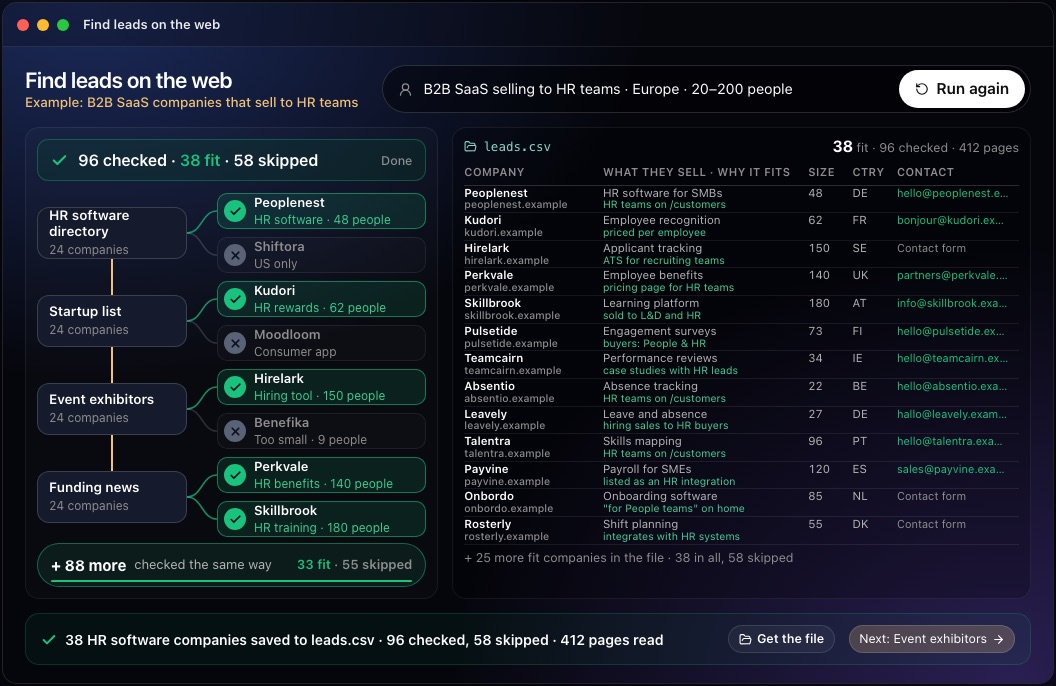
This step in the 10folds window. Example data from the animation on the home page.
Common mistakes
- Starting from a tool instead of a profileFilters without a written profile produce lists that are large and loosely matched.
- Trusting the directory descriptionConfirm fit on the company's own website.
- Buying a list and emailing itPurchased contact lists are often stale, shared widely and risky under data protection rules.
- Guessing email addressesUse routes the company publishes; guessed addresses bounce.
- Forgetting what you already sentWithout a ledger the same companies return each week.
What a good result looks like
- Every company matches the written profile.
- Each row has a one-line reason for the fit and the page that shows it.
- A contact route the company publishes, or a clear note that none was found.
- No company that is already in your CRM or a previous batch.
- A count of companies checked and skipped, with reasons.
And then what? Using the result
- Write a short first message to each company, using the fit reason as the opening.
- Load the batch into your CRM and assign an owner to each company.
- Look at which sources produced the most companies that fit, and weight the next batch toward them.
- Tighten the profile if many skipped companies failed on the same condition.
- Run the next batch before this one is fully worked, so outreach never waits.
When to run it
- When outbound sales is a regular channelA weekly batch keeps prospecting steady without someone stopping sales work to research.
- When entering a new market or countryA first batch shows whether companies matching your profile exist there and how easy they are to reach.
- When bought data has stopped workingReplies fall when everyone writes to the same database. Companies found on niche sources and checked by hand are less contacted.
Questions people ask
How to find B2B leads on the web?
Look in places where companies of your type list themselves or are listed: industry directories, startup and member lists, event exhibitor pages, funding and hiring news, and the customers pages of companies that sell to the same buyers. Confirm each one on its own website before you keep it.
How do I find qualified leads?
Write your ideal customer profile first, then check each company against it on its own website. A qualified lead matches the profile on every hard condition and has a reason to buy that you can point to on a page.
Should I buy a lead list?
Usually not as your main source. Purchased contact lists are often out of date, the same names are sold to your competitors, and using personal data from them can breach data protection rules in the EU and UK. They can serve as a starting point if you verify each company yourself.
What is an ideal customer profile?
An ideal customer profile describes the type of company most likely to buy from you and stay: its sector, size, location, business model and the problem you solve for it. It is about companies; buyer personas describe the people inside them.
Is it legal to email B2B leads I find online?
It depends on where the recipient is. Many countries allow business email with a clear opt-out, the EU and UK treat a named person's work email as personal data, and some countries require consent first. Check the rules that apply, and always offer a way to opt out.
How is finding leads different from building a prospect list?
Finding leads discovers new companies on the web, batch after batch. Building a prospect list merges sources you already have, such as exports and event lists, into one clean list. 10folds has a separate job for that.
More jobs in Sales & outbound
Find leads on the web, on your own Mac.Free app. Runs on your Mac with the Claude or Codex plan you already have. Your files stay on your computer.
Download for Mac