
Case chronology: how to build one from the documents
How to build a case chronology from the documents: every dated fact tied to its page, conflicts kept side by side, and gaps flagged for the lawyer.
Free app. Runs on your Mac with the Claude or Codex plan you already have.
What a case chronology is
A case chronology is a list of the dated facts of a matter, in date order, where each entry says what happened, who was involved, which issue it bears on and exactly which document and page it comes from. It is also called a litigation timeline. Lawyers use it for deposition preparation, trial preparation, pleadings and settlement talks, and it is often the first place a weak point in the case shows up.
The method below is how an experienced litigation paralegal builds one by hand. Each step says what to do and why, then how 10folds carries it out. Either way, the chronology is a working draft for the lawyer on the matter to review. It records what the documents say; it is not legal advice and it draws no legal conclusions.
What it does for the business
- Understand a new matter fastA sourced chronology turns a folder of emails, letters and exhibits into one story in date order. A lawyer joining the case can see what happened and what is contested in an afternoon.
- Prepare depositions with the documents in handFiltering the chronology by witness shows every fact that person touched, with the page to put in front of them. Questions start from the record instead of from memory.
- Spot conflicting accounts earlyTwo documents that give different dates or attendees for the same event are often the heart of the dispute. Seeing them side by side early shapes discovery requests and strategy.
- Find what is missing from the recordLong silences on an issue, and attachments the documents mention but nobody produced, point to what to ask the client or the other side for.
Case chronology, step by step
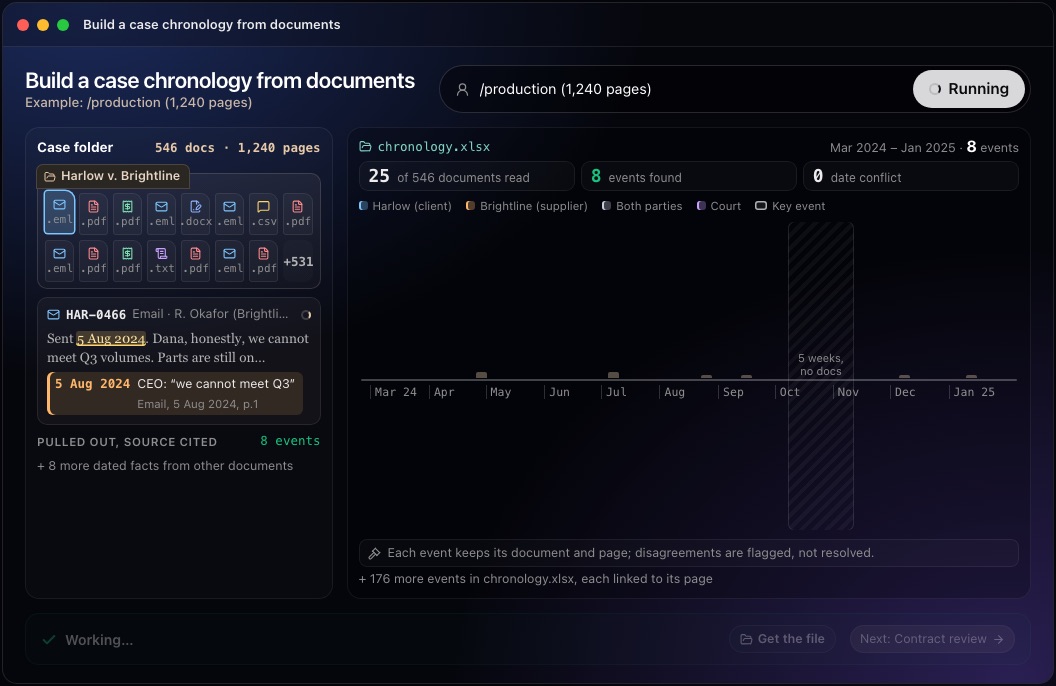
Index every document in the folder
A chronology is only as complete as the list of documents behind it.
What to do
- Give each document a number, or use its Bates number or exhibit label if it has one.
- Record its kind, its own date, author, recipients and page count.
- Note whether each one was read in full, in part or not at all, and why.
- Group exact duplicates and the messages of one email thread, keeping every copy listed.
Why
Without an index, nobody can say which documents the chronology covers. Listing unreadable scans and partial reads up front keeps the lawyer from assuming the record was fully reviewed when it was not.
This step in the 10folds window. Example data from the animation on the home page. Agree the issues and the people with the lawyer
Tag facts by the questions the case will turn on, or you will tag them twice.
What to do
- Propose three to eight issues, each in a few words, such as late deliveries or notice of termination.
- List the people and organizations with every name variant and email address they appear under.
- Ask the lawyer to confirm or correct both lists, and whether any date range or documents should be left out.
Why
Issue tags are what let a lawyer pull every fact on one question. Name variants matter because the same person often signs as a full name, a nickname and an email address, and a chronology that misses this splits one witness into three.
Extract each dated fact with its source
A fact without a page reference is a claim you will have to prove again.
What to do
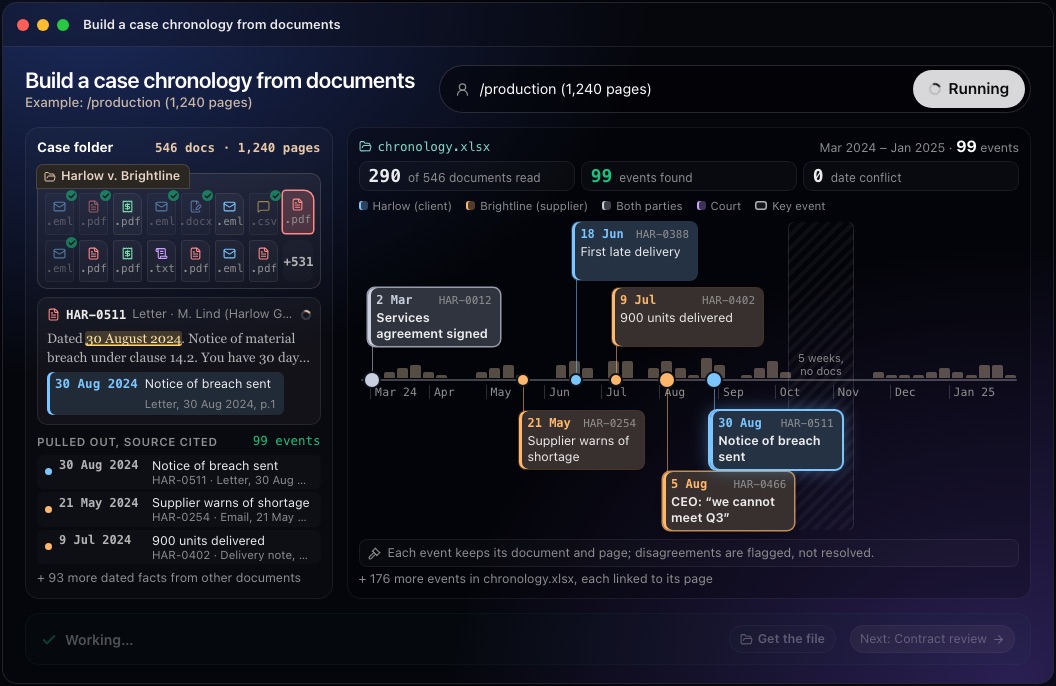
- Write one entry per fact that happened at a point in time: a meeting, a message, a payment, a signature, a deadline.
- Record the date as precisely as the document gives it, and say when a date was worked out from another.
- State what happened in one neutral past-tense sentence: who did what, with no adjectives that judge.
- Cite the source document, page and the exact words, and note whose account it is.
- Put facts with no date on a separate undated list instead of guessing.
Why
A neutral sentence with a quoted source survives scrutiny by opposing counsel. An email describing a meeting is one person's account of it, which is different from the minutes of that meeting, and the chronology should say which is which. Precision matters too: a date given only as a month must not be shown as a specific day, because deadlines and limitation periods can turn on it.
This step in the 10folds window. Example data from the animation on the home page. Check, merge and flag conflicts and gaps
Never resolve a conflict in the record quietly. That is the lawyer's call.
What to do
- Reopen every source and confirm the quoted words are there and support the sentence, the date and the people.
- Merge entries that describe the same event, listing every source.
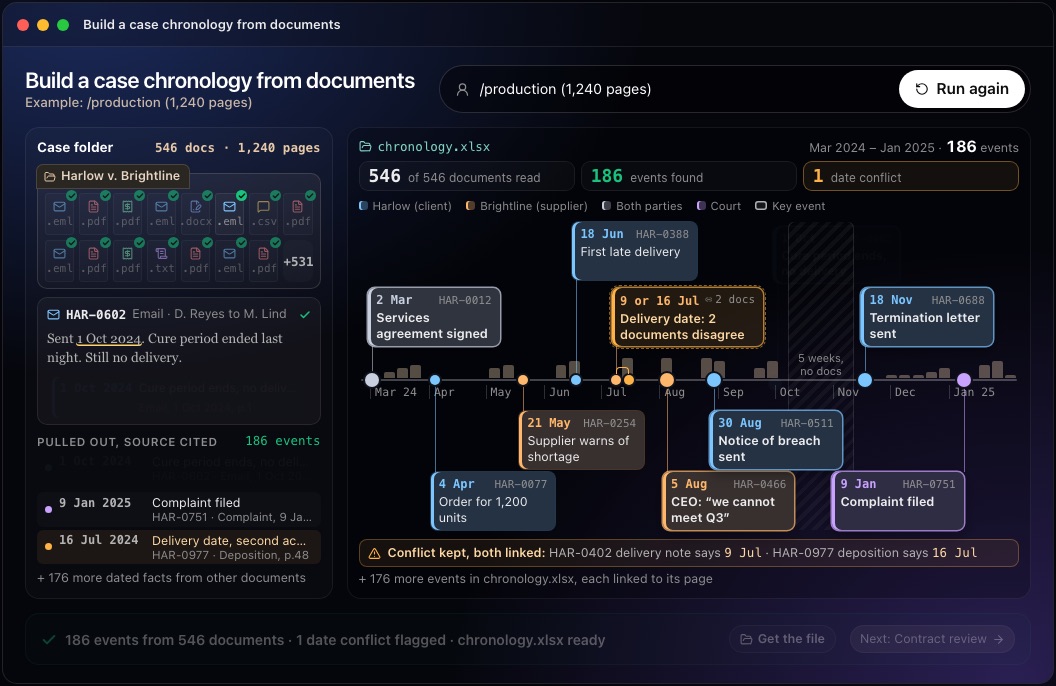
- Mark facts the documents disagree on as disputed, with each version and its source side by side.
- List evidentiary gaps: long silences on an issue, and documents referred to but missing from the folder.
- Mark the key facts sparingly, each with one line on why it matters.
Why
Extraction errors are common in long productions, so a second person checking each line against its source is what makes the chronology trustworthy. Conflicts and gaps are often more useful to the lawyer than the facts everyone agrees on.
This step in the 10folds window. Example data from the animation on the home page. Deliver it, then keep it current
A chronology is finished when the case is.
What to do
- Lead with the one fact or question the case turns on.
- Show the facts by month with key facts, conflicts and gaps marked, then the people involved.
- Export a spreadsheet version for case management tools, with one row per fact and its sources.
- Merge new documents as they arrive and keep the earlier version.
Why
Understanding of the facts changes through discovery, and new documents often move a date or add a version of an event. A chronology that is updated in place, with earlier versions kept, stays useful from the first client meeting to trial.
Common mistakes
- Entries with no page referenceIf nobody can find the source quickly, the entry cannot be used.
- Guessing datesAn undated fact belongs on the undated list, with its source.
- Writing conclusions into the factsWords like admitted or ignored belong in a note marked as analysis.
- Picking one version of a disputed factKeep both, with their sources, and let the lawyer weigh them.
- Building it once and never updating itNew productions change the story. Merge them in and keep the old version.
What a good result looks like
- Every fact with a date, its precision, the people, the issues and an exact quoted source.
- Neutral one-sentence entries, with inferences marked separately.
- Disputed facts shown with each version side by side.
- A list of gaps and missing documents by issue.
- A short list of key facts and the questions for the lawyer.
And then what? Using the result
- Settle the questions for the lawyer with the client first.
- Request the documents the gap list says are missing.
- Filter by witness to build deposition outlines.
- Check the facts section of your brief against the chronology, then run the citation check before filing.
When to run it
- When a new matter comes inBuild it early from whatever the client sends. It is easier to grow a chronology than to start one late.
- After each document productionMerge the new documents so the conflicts and gaps reflect the whole record.
- Before depositionsThe chronology shows every fact a witness touched, with the page to show them.
- Before a mediation or trialThe key facts and disputed points give the lawyer a short, sourced version of the case.
Questions people ask
What is a case chronology?
A case chronology is a date-ordered list of the facts of a legal matter, each tied to the document and page it comes from. It shows what happened, who was involved and where the documents disagree.
How do you build a case chronology?
Index the documents, agree the issues and people, extract each dated fact with its exact source, then have a second person check every entry, merge duplicates and flag conflicts and gaps.
What should a legal chronology include?
For each fact: the date and how precise it is, a neutral sentence on what happened, the people involved, the issues it bears on, and the source document, page and words. Disputed facts, undated facts and gaps belong in it too.
When should you start a case chronology?
As soon as the matter starts. Build it from the first documents and update it after every production, keeping earlier versions.
Does 10folds send my documents anywhere?
No. The documents stay in the project, nothing about the people or the matter is looked up on the web, and nothing is sent to anyone. The case folder is not changed.
Is the chronology legal advice?
No. It records what the documents say, with analysis clearly marked. It is a draft for the lawyer on the matter to review and rely on only after checking.
More jobs in Lawyers
Build a case chronology from documents, on your own Mac.Free app. Runs on your Mac with the Claude or Codex plan you already have. Your files stay on your computer.
Download for Mac