
Legal research memo: how to research and write one
How to write a legal research memo: frame the question, find binding authority, give the short answer first and check every quote against its source.
Free app. Runs on your Mac with the Claude or Codex plan you already have.
What a legal research memo is
A legal research memo is an objective written answer to one legal question on one set of facts, in one jurisdiction. It sets out the question presented, a short answer, the relevant facts, and a discussion that states the rule, applies it to the facts and names the risks. Its reader is usually a supervising lawyer who will decide what to advise, so it must weigh both sides honestly and let every statement of law be traced to its source.
The method below is how a careful associate researches and writes one. Each step says what to do and why, then how 10folds carries it out. Its memo is a first draft for a qualified lawyer to review. It is not legal advice, and it does not replace the lawyer's own reading of the authorities.
What it does for the business
- A faster first draftA structured memo with sources attached gives the lawyer something to review and correct instead of a blank page. The lawyer's time goes to judgment: whether the answer is right, and what to advise.
- Check a position quicklyBefore a call or a negotiation, a short memo on one question shows whether a position holds and where it is weak.
- Brief a client clearlyA short answer backed by sourced reasoning is easy to turn into advice the client understands, once the lawyer has reviewed it. The risk section tells the client what evidence to keep.
- Work that can be checkedWhen every authority is linked and quoted, a reviewer can verify any statement in minutes. Trust in the memo rests on its sources, and a reviewer who disagrees can point to the exact passage.
Legal research memo, step by step
Frame the question and the facts
A vague question gets a vague memo.
What to do
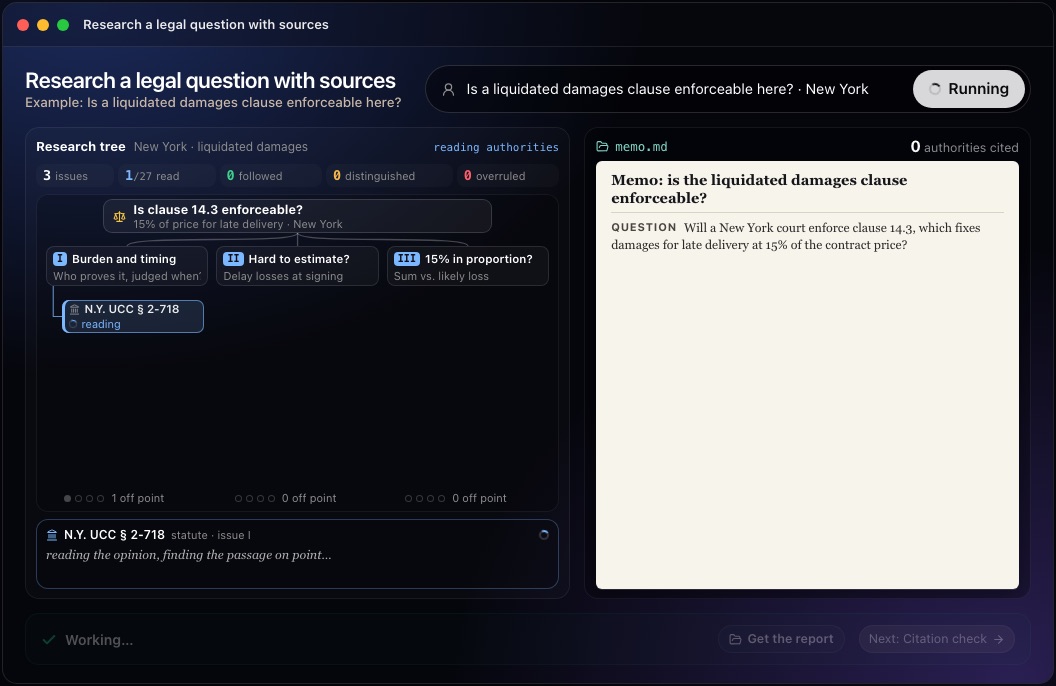
- Write the question presented in one sentence that names the jurisdiction, the legal issue and the key facts.
- List the facts that matter, and mark the ones you are assuming.
- Break the question into the separate issues a court would decide.
- Confirm with the assigning lawyer who will read the memo and how it will be used.
Why
Most wasted research comes from answering a slightly different question than the one asked. Splitting the question into issues gives the research a structure and shows which issue the answer really turns on. Writing down the facts you are assuming matters as much: if one of them turns out to be wrong, the reader knows exactly which part of the answer to revisit. If the question was given to you orally, send back your written version and confirm it before you start.
This step in the 10folds window. Example data from the animation on the home page. Find the authorities and confirm they are good law
An overruled case reads just as well as a good one.
What to do
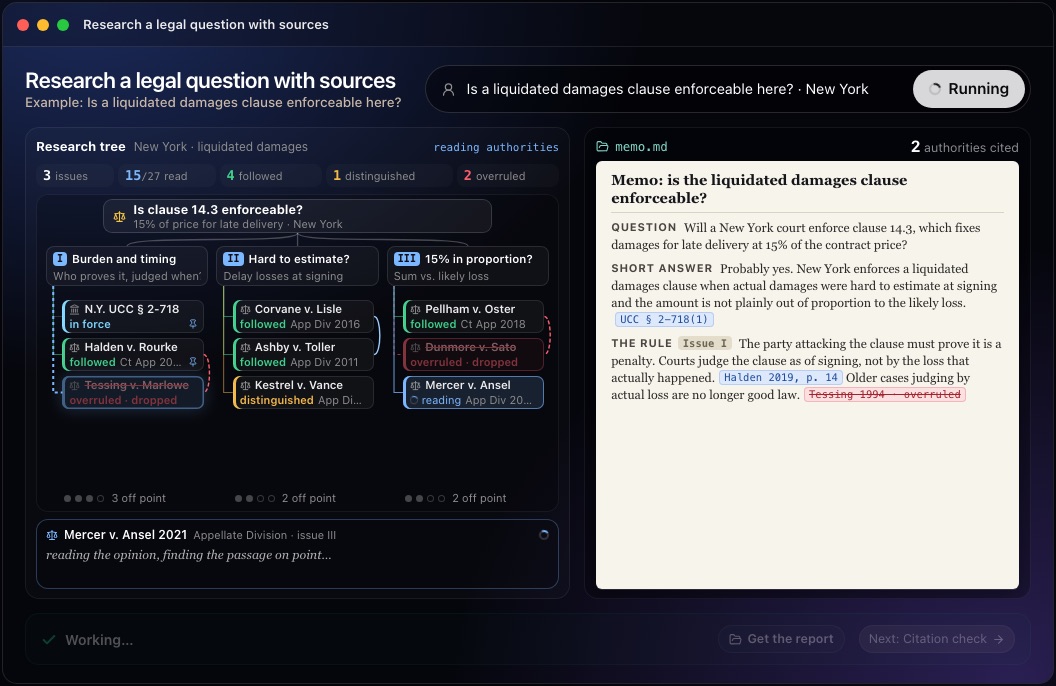
- Start with secondary sources to learn the area and find the leading authorities.
- Find the primary authority: the statutes, regulations and decisions that govern the issue in this jurisdiction.
- Separate binding authority from persuasive authority, and note which court decided each case.
- Check later history for every authority you plan to rely on, and set aside any that were reversed, overruled or repealed.
- Read each authority in full around the passage you rely on. A headnote or summary is not enough.
Why
Persuasive authority from another jurisdiction can mislead a reader who assumes it binds. An authority that is no longer good law can collapse an argument entirely. Reading the full passage is the only way to know the holding fits your facts. Keep a research log as you go, with the sources searched and the date, so a reviewer can see how far the search went and repeat it later.
This step in the 10folds window. Example data from the animation on the home page. Apply the rule to your facts
The rule is only half the answer. The other half is your facts.
What to do
- State the rule in plain words, with its source and pin cite.
- Apply it to your facts, issue by issue.
- Give the strongest argument for the other side and say how a court might respond.
- Name the facts that would change the answer, and what evidence would settle them.
Why
A memo that only restates the law leaves the reader to do the real work. An objective memo also shows the weak points, because the lawyer needs to know them before the other side raises them. Analogy is the core of this step: compare your facts with the facts of the decided cases, and say where they match and where they differ. A rule applied without that comparison is a guess.
Write the memo with the short answer first
If the reader stops after the first paragraph, they should still have the answer.
What to do
- Use the standard format: heading, question presented, short answer, statement of facts, discussion, conclusion.
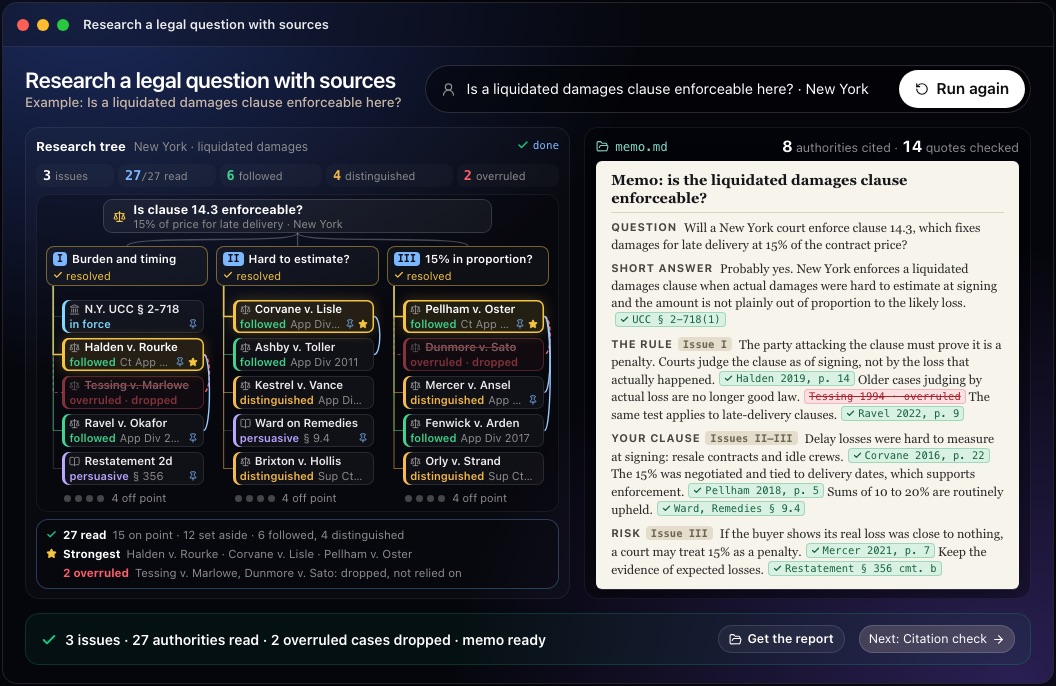
- Make the short answer a direct reply, such as probably yes, with the main reason in one or two sentences.
- Organize the discussion by issue, with headings.
- Write plainly, in the active voice, and keep it as short as the question allows.
- Mark it as privileged and confidential if your practice requires it.
Why
Supervising lawyers read many memos. A clear format and an answer up front let them use yours quickly, and headings by issue let them go straight to the part they doubt. Keeping it short is a discipline: every paragraph should help answer the question presented, and background that does not belongs in an appendix or nowhere.
This step in the 10folds window. Example data from the animation on the home page. Check every quote and citation
A memo is only as reliable as its least-checked citation.
What to do
- Reopen every authority and compare each quote word by word.
- Confirm each pin cite points to the passage relied on.
- Confirm each authority supports the statement it is cited for.
- Have someone else read the memo before it goes to the lawyer.
Why
Quotes drift during drafting, and a citation copied from a secondary source may carry that source's errors. A final check against the originals catches both. The reader of a memo often reuses its quotes in a brief or a client letter, so an error here travels. Check pin cites with particular care: a quote can be accurate while the page number points elsewhere, and a reader who cannot find the passage will doubt the rest of the memo.
Common mistakes
- Researching before framing the questionYou end up answering a question nobody asked.
- Relying on authority from the wrong jurisdictionMark persuasive authority as persuasive.
- Skipping the good law checkOne overruled case can undo the whole discussion, and a reader who finds it will doubt the rest.
- Burying the answerThe short answer belongs at the top.
- Hiding the weak pointsAn objective memo states the risks and the other side's best argument.
What a good result looks like
- A question presented that names the jurisdiction and the key facts.
- A short answer the reader can repeat.
- Each issue discussed with the rule, its source and how it applies.
- Every authority linked, quoted where relied on, and confirmed as good law.
- The risks and the facts that would change the answer.
And then what? Using the result
- Have the supervising lawyer review the memo and its sources.
- Run a citation check on any brief that reuses the memo's authorities.
- Gather the evidence the risk section says you will need.
- Turn the reviewed short answer into client advice.
- Keep the memo and its research log so the question can be updated when the law changes.
When to run it
- A client asks whether a clause or position will holdA short memo answers the question with sources the lawyer can check.
- Before taking a position in a negotiation or disputeIt shows where the position is strong and where it is exposed.
- When starting work in an unfamiliar area of lawWriting the rule and its sources down gives the team a shared starting point, and the research log shows where to look next.
- When a colleague needs a second viewAn independent memo on the same question, with its own sources, shows quickly whether two readings of the law agree.
Questions people ask
How do you write a legal research memo?
Frame the question with its jurisdiction and facts, research the binding authority and confirm it is good law, apply the rule to the facts issue by issue, then write it up with the short answer first and check every quote. Have someone else read it before it reaches the supervising lawyer.
What is the format of a legal memo?
A heading, the question presented, a short answer, a statement of facts, a discussion organized by issue, and a conclusion. Office templates vary, so follow yours if one exists. The discussion is the longest part and does most of the work.
What goes in the short answer of a legal memo?
A direct answer to the question, such as yes, no or probably, and the main reason in one or two sentences. It should make sense on its own.
How do you know an authority is still good law?
Check its later history with a citator or the official source: whether a decision was reversed or overruled, or a provision repealed or amended. Do this for every authority you rely on. If you cannot check it, say so in the memo rather than assuming it is still in force.
Does 10folds give me legal advice?
No. The memo is a first draft for a qualified lawyer to review, with every authority linked and quoted so it can be checked. The lawyer decides what to advise and whether to rely on each authority.
What do I need to give it?
The question and the jurisdiction. The clearer the question and the facts behind it, the more precisely any memo, by hand or by an AI employee, can apply the rule.
More jobs in Lawyers
Research a legal question with sources, on your own Mac.Free app. Runs on your Mac with the Claude or Codex plan you already have. Your files stay on your computer.
Download for Mac