
How to write a sales proposal from your call notes
How to write a sales proposal clients can say yes to: their problem in their words, a clear scope, transparent prices, exclusions and one next step.
Free app. Runs on your Mac with the Claude or Codex plan you already have.
What a sales proposal is
Learning how to write a sales proposal means learning to turn a conversation into a written offer a client can approve. A good proposal restates the client's problem in their words, says exactly what you will deliver and what you will not, shows how the price is built, and ends with one clear decision. It is usually short. Its job is to confirm what was discussed, so the client can agree and share it with whoever else signs.
The method below is how an experienced account executive writes one by hand. Each step says what to do and why, then how 10folds carries it out.
What it does for the business
- Send the proposal while the call is freshA proposal that arrives the same day or the next keeps momentum and shows the client you listened. Each day of delay gives the deal time to cool, and gives a competitor time to send theirs first.
- Avoid disputes over scope and priceClear deliverables, exclusions and acceptance criteria mean both sides know what was bought. Changes later become a conversation about new scope instead of a disagreement.
- Keep pricing consistentPrices drawn from your price list, with the arithmetic shown, stop one-off discounts and calculation errors from creeping into deals.
- Help your champion sell internallyThe person you spoke to often has to convince a manager or a finance team. A short, clear proposal is the document they forward. If it answers the questions those readers will ask, your champion does not have to.
How to write a sales proposal, step by step
Collect what the client told you
The best proposals quote the client back to themselves.
What to do
- Read your discovery call notes or transcript, and underline the client's own words for the problem.
- Note the outcomes they asked for, their timeline and any constraint they mentioned.
- Record who decides, who uses the result and who else must approve.
- Gather your current price list, standard terms and one or two past proposals for the same kind of client, so structure and wording stay consistent.
Why
Clients approve proposals that describe their situation accurately. Working from notes instead of memory stops you from proposing what you usually sell instead of what this client asked for. Knowing who else approves tells you what they will need to read: a finance reader looks for the total and the terms, a user looks for the timeline.
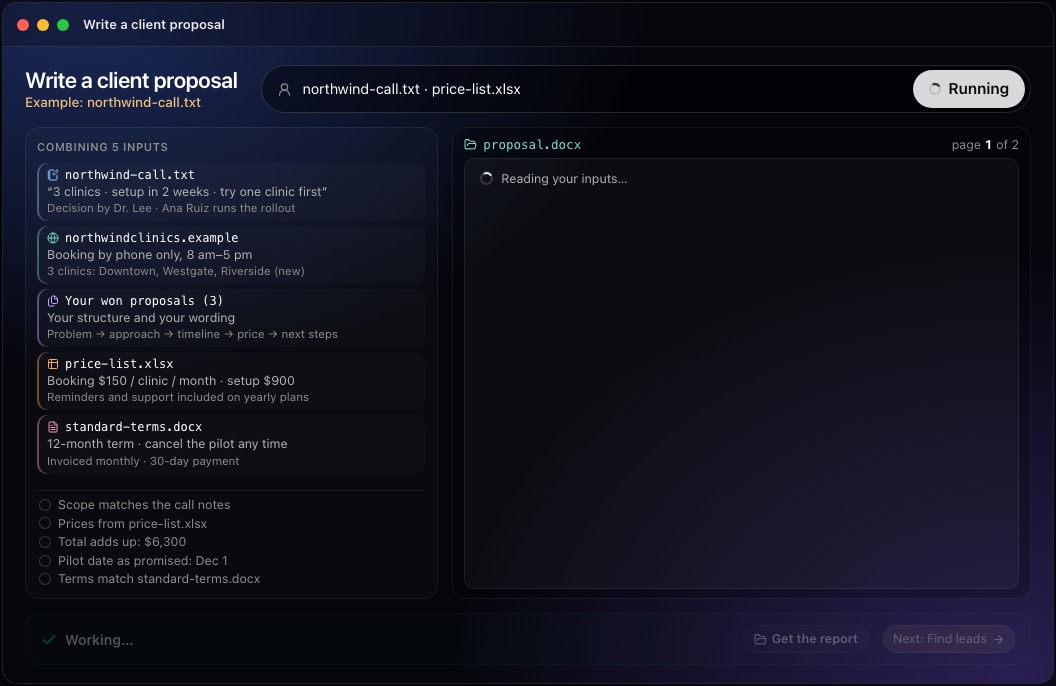
This step in the 10folds window. Example data from the animation on the home page. Define the scope of work and what is excluded
Everything you leave unsaid in a proposal, the client will assume is included.
What to do
- Write the scope of work as concrete deliverables: what, how many, by when.
- List the dependencies: what the client must provide, and when.
- List exclusions plainly, especially the items the client might assume are included.
- Write acceptance criteria that describe observable delivery, such as the system live in one clinic, never a business result you cannot control.
Why
Most disputes after signature come from scope that was never written down. Acceptance criteria tied to delivery let both sides agree when the work is done. Dependencies matter as much: a project that waits three weeks for the client's data is late through no fault of yours, and the proposal is where you say so in advance.
Build the price so it can be checked
A price the client can recompute is a price the client can approve.
What to do
- Take every price from your current price list or an approved quote.
- Show the arithmetic in a pricing table: item, quantity, unit price, total.
- Separate optional items from the base price, so the client can choose without renegotiating.
- State payment terms, the contract length and what happens at renewal.
- Flag any discount or unusual term for approval before it goes in.
Why
Hidden or rounded totals invite questions and delay. A transparent table lets the client's finance team check the figure quickly. Options give the client a choice besides yes or no. Keeping them separate also means the base price is never quietly inflated by extras the client did not ask for.
Write the proposal
Write it so the person who was not on the call understands it.
What to do
- Open with a short executive summary of the client's need and your answer to it.
- Follow with scope, deliverables, timeline, price, exclusions and next steps.
- Add proof that fits: one or two short case studies or references from similar clients.
- Use a proposal template for structure, then remove everything that does not apply to this client.
- Keep it as short as the deal allows; two or three pages are often enough.
Why
A clear order helps busy readers find the scope and price quickly. Proof from similar clients answers the question every buyer asks: has this worked for someone like us. Removing generic material keeps attention on what this client is buying.
Check it before it goes out
Read it as the client's finance team will.
What to do
- Check that the scope matches what was agreed on the call, and nothing more.
- Recompute every total and check each price against the price list.
- Check dates, names and promises against your notes.
- Have someone else read it for anything that sounds like a guarantee.
- Make sure legal or commercial terms that need approval have been approved.
Why
A wrong total or an extra promise costs more after signature than before it. A second reader sees what the writer assumed. Checking against the original notes, not the draft, is what catches a promise that crept in during writing.
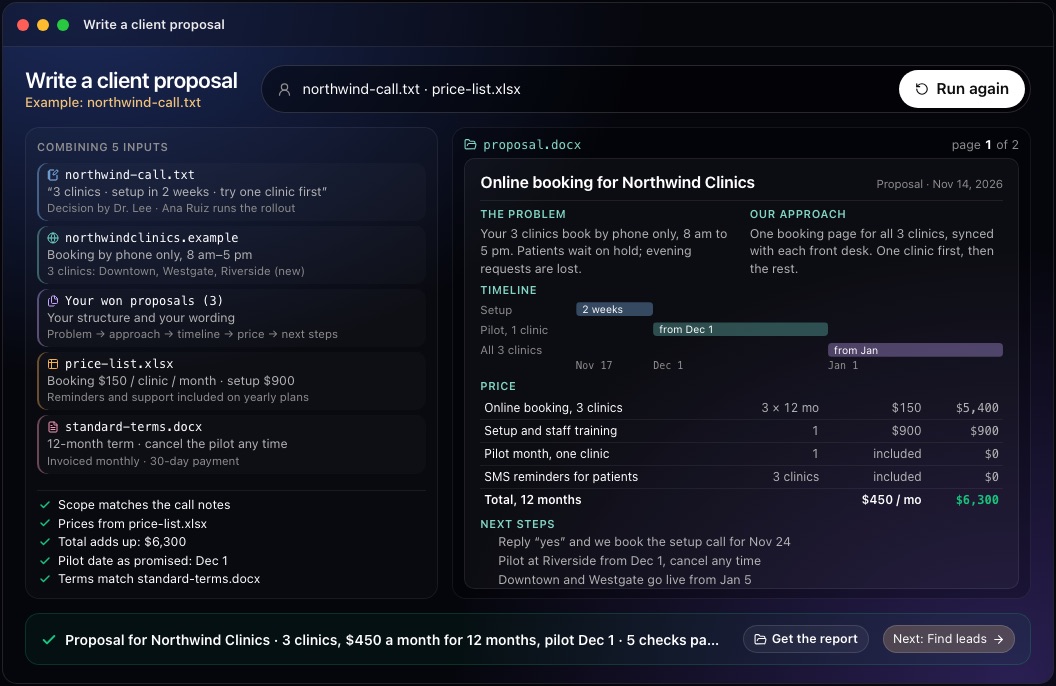
This step in the 10folds window. Example data from the animation on the home page.
Common mistakes
- Talking about yourself firstOpen with the client's problem; your company history can wait or go.
- Leaving the scope vagueUnwritten scope becomes free work or a dispute.
- Hiding how the price is builtShow the arithmetic so finance can approve it quickly.
- Promising resultsCommit to delivery you control, and keep outcomes as goals.
- Ending without next stepsName the decision you need, who makes it and by when.
What a good result looks like
- The client's problem in their own words on the first page.
- Deliverables, dependencies and exclusions written out.
- A pricing table whose totals anyone can recompute.
- Acceptance criteria that describe observable delivery.
- One next step with a date.
And then what? Using the result
- Answer the open commercial terms flagged for review.
- Send the proposal with a short note that names the next step.
- Book a call to walk the client through it, if the deal is large.
- Save the final version as a reference for similar proposals.
- Follow up on the date you named.
When to run it
- Right after a discovery or scoping callThe notes are fresh and the client is waiting. A same-day draft keeps the conversation moving.
- When several people send proposalsDrafting from one price list and standard terms keeps scope and price consistent across the team.
- When a client asks for a revised offerRebuilding from the notes and the price list shows exactly what changed in scope and price.
- When a proposal will be forwarded to people you have not metA finance or procurement reader needs the scope, the price arithmetic and the exclusions spelled out. Writing for them from the start avoids a second round of questions.
Questions people ask
What should a sales proposal include?
A short executive summary of the client's need, the scope of work and deliverables, exclusions, acceptance criteria, timeline and dependencies, a pricing table, payment terms, relevant proof and clear next steps.
How long should a sales proposal be?
As short as the deal allows. For most small and mid-sized deals, two or three pages are enough. Longer documents suit complex projects, where the scope needs more detail. Put supporting material such as detailed specifications or terms in an appendix, so the main pages stay readable.
How do you price a proposal?
Start from your price list, show quantity and unit price for each item, add the totals, and separate optional items from the base. Offering a small number of options helps the client choose without renegotiating. Any discount should be shown as a separate line, so the list price stays visible.
What is the difference between a proposal and a quote?
A quote states prices for defined items, often with little else. A proposal adds the client's problem, your approach, scope, exclusions, timeline and proof. Use a quote when the client knows exactly what to buy, and a proposal when they are choosing how to solve a problem.
How to write a sales proposal quickly after a call?
Start from the call notes and your price list, reuse the structure of a past proposal for a similar client, and write the client's problem first. Then fill in scope, price and next steps, and have someone check totals and promises before sending.
Will 10folds send or sign the proposal?
No. It drafts the proposal from your notes and pricing, and marks the terms you still need to decide. You review it, approve any legal or commercial terms, then send it yourself.
More jobs in Sales & outbound
Write a client proposal, on your own Mac.Free app. Runs on your Mac with the Claude or Codex plan you already have. Your files stay on your computer.
Download for Mac