
AI visibility tracking: how to measure your brand in AI answers
AI visibility tracking explained: ask AI assistants your buyers' questions each week, count mentions and citations, and act on the questions you lose.
Free app. Runs on your Mac with the Claude or Codex plan you already have.
What AI visibility tracking is
AI visibility tracking is the regular work of asking AI assistants the questions your buyers ask, and recording which answers name your business, which name competitors, and which pages the answers cite. Assistants such as ChatGPT, Perplexity, Gemini or Google's AI Overviews now answer many questions that used to send people to a list of links. If a buyer asks for the best option in your category and your name is missing, you never see that lost visit.
The work is close to rank tracking, with two differences. Answers change from one run to the next, so one check proves little. And the useful output is a short list of pages to create or fix. The method below is how an SEO specialist does it by hand. Each step says what to do and why, then how 10folds carries it out.
What it does for the business
- See a channel your analytics cannot showWhen an assistant answers a buyer directly, no visit reaches your site and no report records it. Tracking the answers shows whether you are part of that conversation at all.
- Know which sources assistants trustAnswers lean on a small set of pages: review sites, lists, guides, sometimes your own pages. Knowing which ones tells you where effort will count.
- Act on facts about lossesA list of the exact questions where a competitor is named and you are not turns a vague worry into specific pages to write or listings to get onto. Each action is tied to the answers and cited pages behind it, so it can be checked before anyone spends time on it.
- Give clients a new metric they can followAgencies can report the same panel every week, with the same denominators, so a change in visibility can be seen and explained.
AI visibility tracking, step by step
Write a fixed panel of buyer questions
Measure the questions buyers ask, not the ones you would like to be asked.
What to do
- Read your own site first: products, pricing, comparisons, common questions and customer stories.
- Write 20 to 40 prompts the way buyers type them: "which X for Y", "how do I", comparisons and alternatives.
- Keep questions that contain your brand name in a separate group.
- List the competitors to watch, with their aliases and domains.
- Freeze the panel. If a question, competitor or model changes, start a new version.
Why
Brand questions almost always return your name and inflate the score. A panel that changes every week cannot show a trend, because you would be comparing different tests.
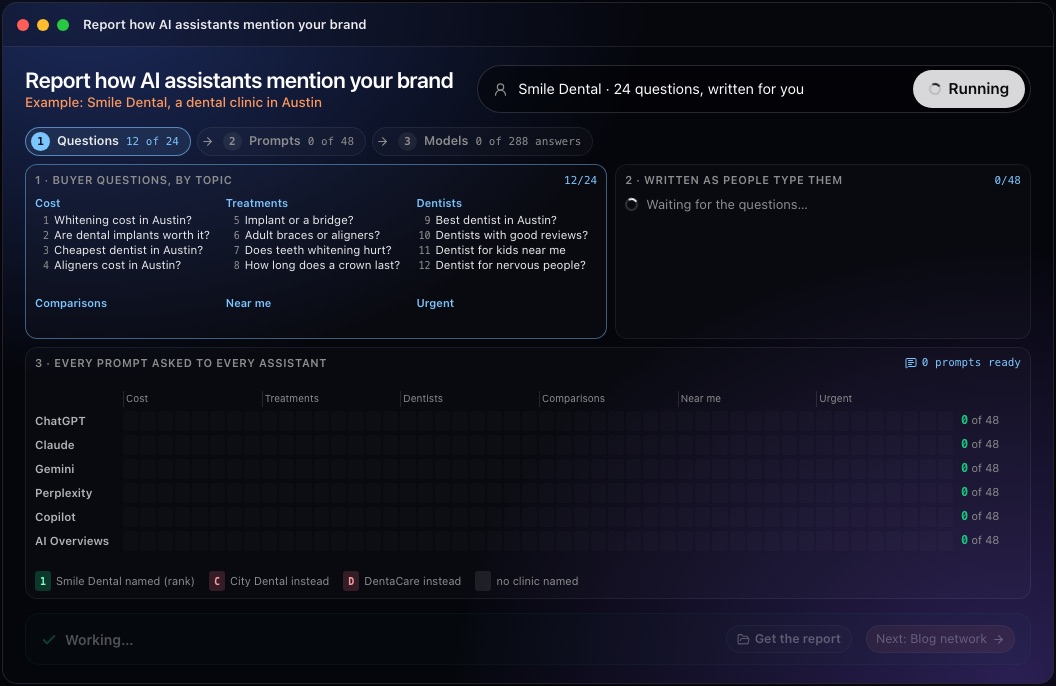
This step in the 10folds window. Example data from the animation on the home page. Ask every question several times and keep every answer
An answer you did not save is an answer you cannot check.
What to do
- Ask each question three times, each in a new conversation, in each assistant your customers use.
- Save the full answer, the source links, the assistant, the model and the date.
- Record failed and missing answers as failures.
- Keep the same language, location and models from week to week.
Why
The same prompt can name you in one answer and leave you out in the next. Three samples per question give a fairer picture, and the raw text lets anyone recheck a count later. Keeping the language, location and models fixed matters for the same reason: an assistant asked in another country or through another model is a different test.
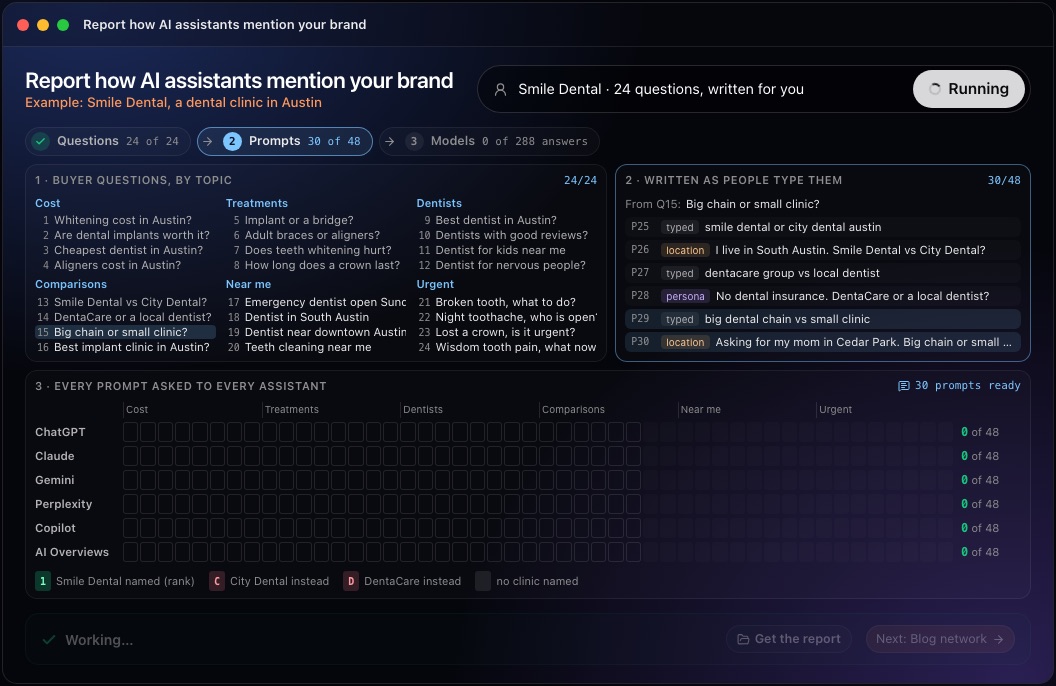
This step in the 10folds window. Example data from the animation on the home page. Count mentions, share of voice and citations
A percentage without its denominator is a rumor.
What to do
- Mention rate: in how many answers your brand is named, out of the answers that succeeded.
- Share of voice: your mentions compared with all brand mentions, yours and competitors'.
- Position: where you appear in an explicit numbered list. Order in prose is not a rank.
- Citations: how often your own domain is cited as a source.
- Compare with last week only when the panel, model and mode are the same.
Why
Each measure answers a different question. A brand can be named often but never cited, or cited once as the top choice. Mixing models or panels makes a trend that means nothing. Citations deserve their own line: when an answer links to your page, the reader has a route to you, and the assistant has shown which of your pages it considers a source.
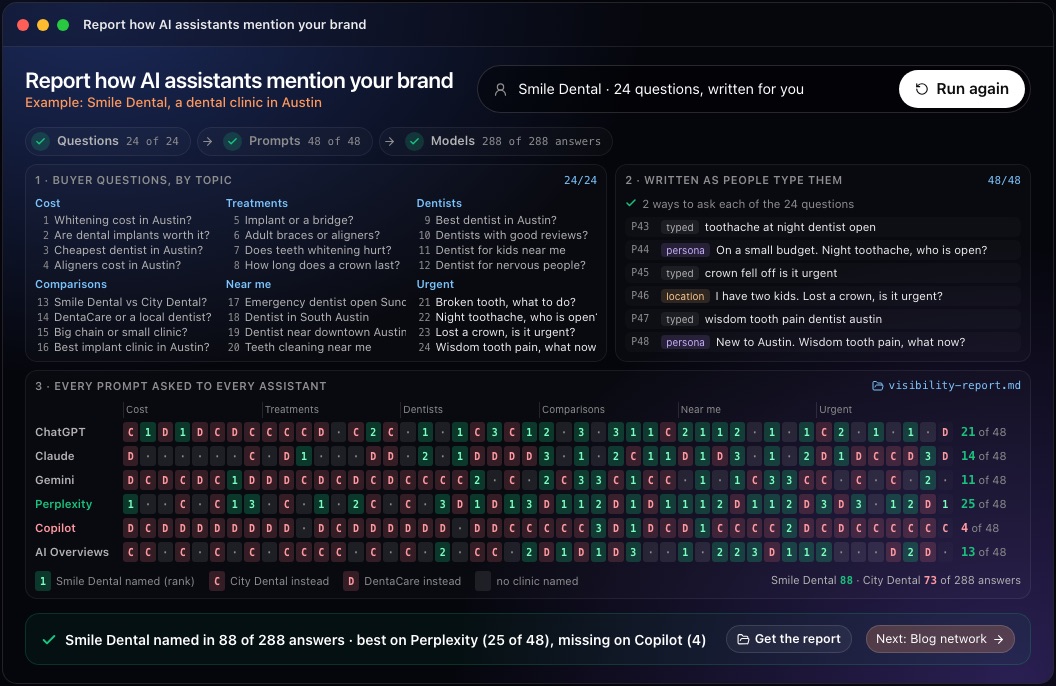
This step in the 10folds window. Example data from the animation on the home page. Check the counts against the raw answers
Automatic name matching is fast and sometimes wrong.
What to do
- Take a sample of answers, at least one per model, and recheck every name match.
- Recheck the answers behind the biggest losses.
- Compare list positions and cited links with the raw text.
- Check what each answer says about your business against your own site.
Why
A competitor with a common word in its name, or a brand mentioned only to be dismissed, can distort the counts. Wrong facts about your business are a finding in themselves, because they show which page needs to state the truth. A short, documented check also lets a client or a colleague trust the numbers without redoing the work.
Turn each lost question into one action
A citation shows what an answer used. It does not promise what the next one will use.
What to do
- List every non-brand question where a competitor is named and you are not.
- Open the pages those answers cite, and your closest page.
- No page answers the question: plan the page, with a direct two-sentence answer and the facts to state.
- A page exists but lacks what the cited pages say: add that section.
- Answers lean on third-party lists or reviews: decide which ones to get onto.
Why
This is the part of generative engine optimization that changes anything. A visibility score alone does not tell anyone what to do on Monday. Each loss points to one of four causes: no page answers the question, a page exists but lacks the facts others state, answers lean on third-party lists, or an answer repeats a wrong fact. Each cause has a different fix.
Common mistakes
- Checking once by handA single answer can be the exception. Sample each question several times.
- Counting brand questionsThey always name you. Report them apart.
- Changing the panel quietlyA new question set breaks the trend. Version it.
- Treating a failed answer as zeroIt is missing data, and it should be shown as such.
- Promising mentionsNo one controls what an assistant says. Report what changed and why it may have.
What a good result looks like
- One headline: named in n of m buyer questions, against the leading competitor.
- Mention rate, share of voice and citations, each with its denominator, per model.
- Every lost question, who is named instead and which page is cited.
- One action per loss, with a priority and a confidence.
- A note on how far to trust the numbers: sample size, failures and judgments.
And then what? Using the result
- Create or fix the page behind the most repeated loss first.
- Correct any wrong fact about your business on your own site.
- Apply to the third-party lists and review sites the answers cite most.
- Keep the panel unchanged and run it again next week.
When to run it
- Every week, for any business whose buyers research onlineA steady weekly run on the same panel is the only way to see a real change.
- Before and after publishing a key pageComparing runs on the same panel shows whether answers start citing the new page.
- For agency clientsIt adds a reported measure of AI search with clear denominators and evidence behind each number.
Questions people ask
What is AI visibility tracking?
AI visibility tracking measures how often, and how favorably, AI assistants name and cite your business when people ask questions about your category. It uses a fixed set of prompts, asked on a schedule, with every answer saved so the counts can be checked.
How do you track brand mentions in ChatGPT?
Write a fixed list of buyer questions, ask each one several times in new conversations, save every full answer with its sources, then count in how many answers your brand is named. Repeat with the same questions every week.
What is share of voice in AI search?
It is your share of all brand mentions in the answers: your mentions divided by the mentions of you and your competitors together.
Why do AI answers change between runs?
Assistants generate each answer fresh, and their search results and models change over time. That is why each question should be asked several times and compared only with runs on the same model.
How do you get mentioned by AI assistants?
Make sure a clear page on your site answers each buyer question directly, with the facts stated plainly, and get listed on the third-party pages that answers already cite. No method guarantees a mention.
Does 10folds ask ChatGPT and the others directly?
It collects answers only through an AI service already connected and authorized on your computer, or imports answers you saved by hand. Without either, it still delivers the question panel and shows which of your pages answers each question.
More jobs in SEO agencies
Report how AI assistants mention your brand, on your own Mac.Free app. Runs on your Mac with the Claude or Codex plan you already have. Your files stay on your computer.
Download for Mac