
Contract review playbook: how to review a contract against it
How to use a contract review playbook: compare the versions, map each changed clause to an approved position and send the exceptions to the right owner.
Free app. Runs on your Mac with the Claude or Codex plan you already have.
What a contract review playbook is
A contract review playbook is a written set of your organization's approved positions on each clause it negotiates: the preferred position, the fallback positions a reviewer may accept, and who must approve anything beyond them. Reviewing a contract against it means reading the counterparty's draft clause by clause, finding every deviation from those positions, and deciding for each one whether to accept it, propose approved wording or escalate it.
The method below is how an experienced commercial lawyer or contract manager does it. Each step says what to do and why, then how 10folds carries it out. Its result is a first pass for a qualified reviewer. It is not legal advice and it approves nothing.
What it does for the business
- Faster turnaround on routine contractsWhen most changes fall inside approved positions, a reviewer can clear them quickly and spend time on the few that need a decision. Sales and procurement wait less for legal.
- The same answer from every reviewerA playbook applied clause by clause gives consistent positions whoever does the review. The company stops conceding a point in one deal that it holds in the next.
- Clear escalationEach exception goes to the person authorized to approve it, with the clause, the change and the rule side by side. Approvers decide from evidence instead of a forwarded email thread.
- A record of what was agreed and whyA change matrix that ties every accepted deviation to a rule or an approver makes later renewals and disputes easier to handle.
Contract review playbook, step by step
Confirm the versions and the playbook
You cannot review a change until you know what it changed from.
What to do
- Identify the baseline, usually the last version you sent, and the counterparty's new version, with dates.
- Confirm the parties, your contracting entity and the transaction type.
- Check that the playbook is the current approved version and that its rules apply to this kind of deal.
- If there is no approved playbook, limit yourself to listing the changes and hold back recommendations.
Why
Reviewing the wrong version, or applying positions written for a different contract type, produces confident advice that is simply wrong. A playbook for a supplier agreement, for example, may take the opposite position on liability from one written for a customer agreement. An unapproved playbook carries no authority, so recommendations built on it cannot be relied on.
Read every clause and list what changed
The change that hurts is often in a definition nobody redlined.
What to do
- Read both versions completely, including schedules, tables and definitions.
- Align them by clause heading and paragraph, and record insertions, deletions, moved text and changed numbers or dates.
- Keep the exact before and after wording with its location.
- Note unchanged clauses whose meaning shifts because a defined term changed.
- Treat a clause that moved without changing as no change.
Why
Tracked changes can be incomplete, whether by accident or because a document was re-saved. A changed definition can alter a dozen clauses that look untouched. A complete change list is what makes the rest of the review trustworthy.
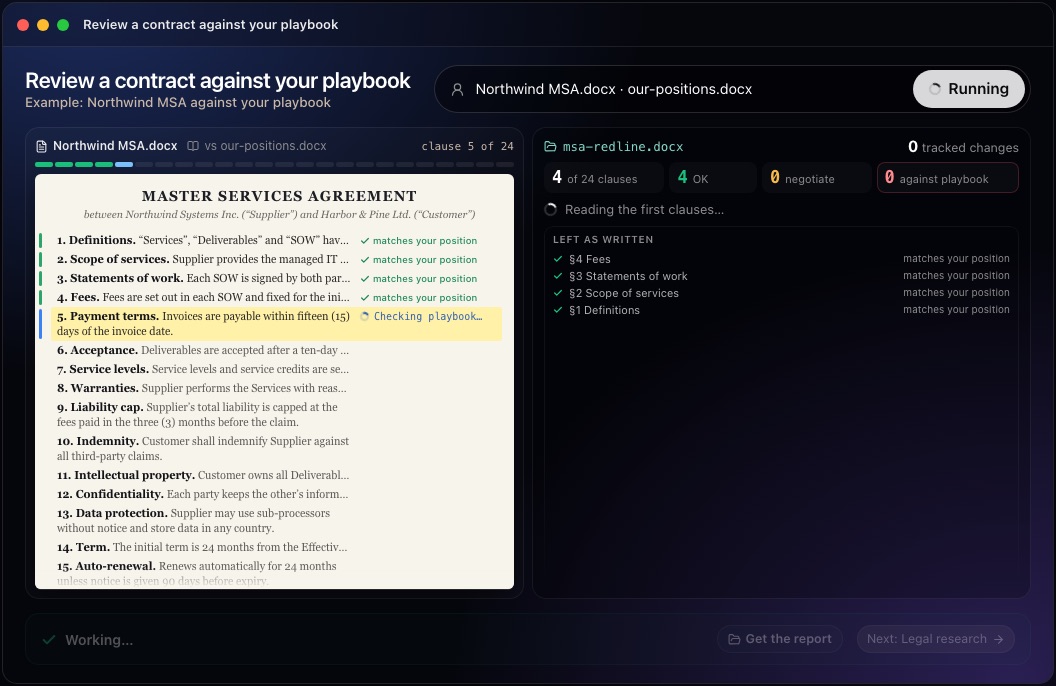
This step in the 10folds window. Example data from the animation on the home page. Compare each change with the playbook
A playbook that is silent on a clause has not approved it.
What to do
- Find the playbook rule for each changed clause, with its preferred and fallback wording.
- Classify each change: within the preferred position, within an authorized fallback, needs exception approval, no applicable rule, or unable to assess.
- Keep any stricter approval conditions attached to a fallback.
- Note the business effect only where the clause change itself shows it.
- Leave risk ratings out unless the playbook defines them.
Why
These categories decide what happens next: a change inside the preferred position is accepted, an exception goes to an approver, and an unmapped clause goes to counsel. Inventing a risk score the playbook does not define gives a false sense of precision. Keeping the fallback conditions attached matters too: a fallback that is approved only for deals under a set value, or only with a sign-off, is an exception everywhere else.
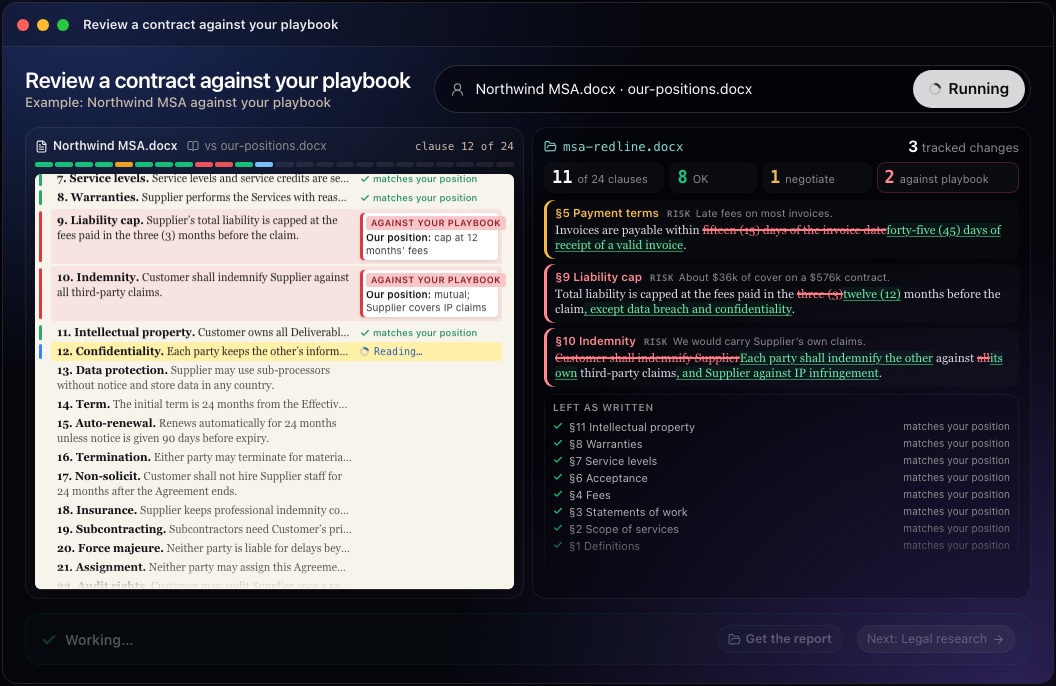
This step in the 10folds window. Example data from the animation on the home page. Draft the redline and the comments
Propose the approved words, exactly as approved.
What to do
- For each change outside the preferred position, write a comment ready to paste into the document.
- Show the original text, the counterparty's text and the proposed text separately.
- Copy approved replacement wording exactly from the playbook.
- Write a precise question to counsel for every clause with no rule.
- Check amounts, dates, party names and cross-references against both versions.
Why
Paraphrased fallback wording may no longer be the wording the approver signed off on. Linked clauses also matter: a new remedy in one clause can contradict a limit in another, and a redline that fixes one and ignores the other creates a new problem.
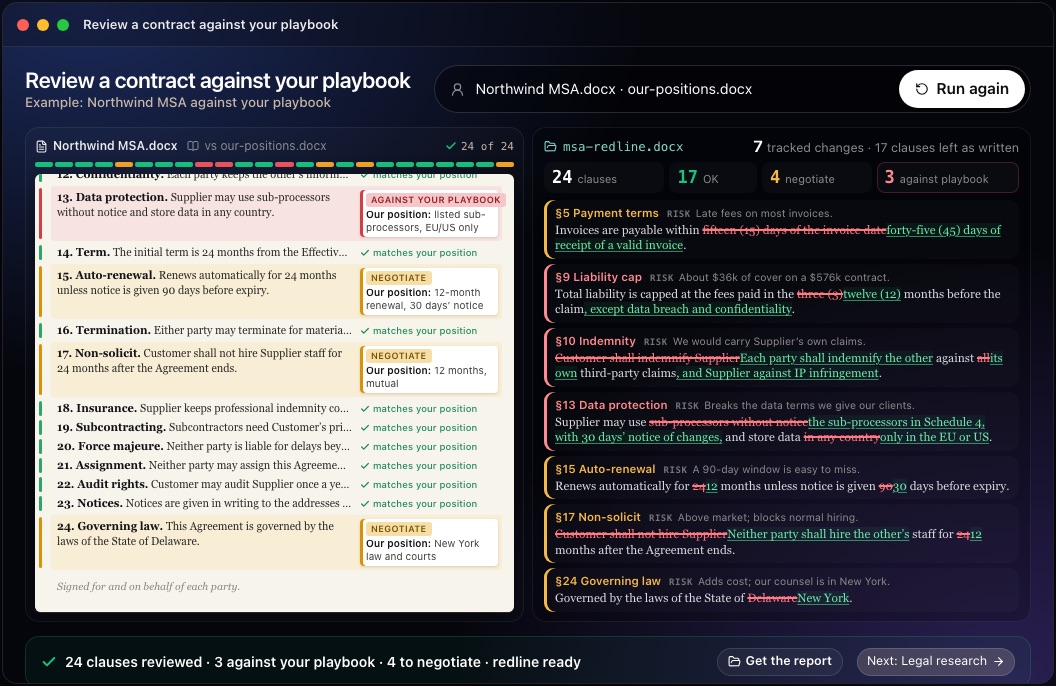
This step in the 10folds window. Example data from the animation on the home page. Route the exceptions and hand over
Each decision belongs to someone. Name them.
What to do
- List the exceptions and unmapped clauses first, each with its owner and proposed action.
- Include the changes within the playbook so coverage is visible.
- Give counts of clauses reviewed against the total in scope.
- Send the pack to the qualified reviewer before anything goes back to the other side.
Why
An approver should see the decisions first, without reading the whole contract. Showing within-rule changes as well lets the reviewer confirm nothing was skipped. A count of clauses reviewed against the total in scope makes any gap obvious, and the reviewer's sign-off before anything goes back keeps a first pass from being read as the company's position.
Common mistakes
- Trusting the tracked changesCompare the full text of both versions yourself.
- Treating no rule as acceptableAn unmapped clause needs a question to counsel.
- Paraphrasing fallback wordingUse the approved text word for word, or it is no longer approved.
- Missing changed definitionsOne new definition can change clauses that show no redline.
- Escalating without evidenceGive the approver the clause, the change and the rule in one place.
What a good result looks like
- Every changed clause listed with exact before and after text and its location.
- Each change mapped to a playbook rule, or flagged as having none.
- Paste-ready comments using approved wording exactly.
- Exceptions first, each with its owner and proposed action.
- A clear statement of scope, missing documents and what still needs a decision.
And then what? Using the result
- Get the exceptions approved or declined by the owners named.
- Send counsel the questions on clauses the playbook does not cover.
- Add a rule to the playbook for any clause that keeps coming up unmapped.
- Return the agreed comments to the counterparty after the qualified reviewer signs off.
- Once signed, list the obligations and deadlines the contract creates.
When to run it
- A counterparty sends back your template with changesThe review shows which changes you can accept under the playbook and which need approval.
- Volume contracts such as NDAs and order formsMost changes in routine agreements fall inside approved positions, so a playbook review clears them quickly and leaves the rare exception clearly marked for a decision.
- New team members review contractsThe playbook and the change matrix keep their positions aligned with the rest of the team.
- Before the final round of negotiationA last comparison catches late changes slipped into a clean version.
Questions people ask
What is a contract review playbook?
A contract review playbook is a document that sets out an organization's preferred position on each clause, the fallback positions a reviewer may accept, and who approves anything else. It makes contract review consistent across reviewers.
How do you review a contract against a playbook?
Compare the new version with your baseline clause by clause, list every change, find the playbook rule for each, classify it as within position, within fallback or an exception, then draft comments and route exceptions to their approvers.
What should a contract playbook include?
For each clause it covers: the preferred wording, approved fallback wording, the conditions for using each, and the person authorized to approve deviations. Many teams also keep a contract review checklist for the clauses every deal must contain.
When should a contract deviation be escalated?
Whenever it falls outside the preferred and fallback positions, or the playbook has no rule for it. The playbook should name who approves each kind of exception.
Does 10folds draft the redline?
It writes paste-ready comments with approved replacement wording copied exactly, as a proposal. It does not edit your source files or present a proposal as an approved redline.
Is this legal advice?
No. The result is a first pass for a qualified reviewer. It approves nothing, and the decisions stay with the people your playbook authorizes.
More jobs in Lawyers
Review a contract against your playbook, on your own Mac.Free app. Runs on your Mac with the Claude or Codex plan you already have. Your files stay on your computer.
Download for Mac