
Cite checking: how to verify every citation before filing
Cite checking step by step: confirm each authority exists, every quote matches, the pin cite is right and the source supports the sentence before you file.
Free app. Runs on your Mac with the Claude or Codex plan you already have.
What cite checking is
Cite checking is the work of opening every authority a legal brief relies on and confirming four things: the authority exists, the citation details are right, every quoted word matches the source, and the passage really says what the sentence claims. It is done before filing, after the last substantive edit, by someone other than the author. A clean check means the court will not find what you missed.
The method below is how an experienced paralegal or junior associate does it by hand. Each step says what to do and why, then how 10folds carries it out. The result of either is a draft for the supervising attorney to review. It is not legal advice, and the decision to file stays with a qualified lawyer.
What it does for the business
- File without a citation you cannot defendA court that finds a missing case or a wrong quote stops trusting the rest of the brief. Checking every authority before filing removes that risk at the stage where it is cheapest to fix.
- Check AI-drafted text safelyDrafting tools can produce citations that look right and point to nothing. Citation verification source by source catches them before they reach the court, whoever or whatever wrote the first draft.
- Review a colleague's draft in minutesA table that shows the sentence, the source passage and the verdict side by side lets a partner see at a glance which citations need attention. Review time goes to the real problems.
- Keep a record of what was checkedA written cite-check record shows which sources were opened, when, and what was found. It supports the supervising attorney's sign-off and any later question about the filing.
Cite checking, step by step
List every citation and every legal statement
You cannot check a citation you never noticed.
What to do
- Read the draft from start to end and number each citation in reading order.
- Record where it sits, the full sentence, the citation exactly as written, the pin cite and any quoted words.
- Write one neutral line for each: what the sentence says this authority holds.
- Resolve every short form, such as id. or supra, to the full citation it points to.
- Flag sentences that state a rule of law with no authority at all.
Why
A cite check that starts from memory or from a table of authorities misses short forms, string cites and unsupported statements. Writing the proposition down for each entry is what makes the later support check possible.
Find each authority at its source
A citation is verified when someone has read the document itself.
What to do
- Start with copies the team already downloaded for the matter.
- Then use official or free public sources: the court's own site, the official code or journal.
- Open the document and copy the passage at the pin cite exactly.
- If several authorities match, list them and note which one the draft most likely means.
- If you cannot find it, record where you looked. Do not conclude that it does not exist.
Why
Most fabricated or garbled citations survive because someone trusted a snippet, a headnote or the tool that produced them. AI hallucinations, citations a drafting tool invents that look real, are caught only this way. Opening the source and copying the passage turns a belief into evidence that the next reviewer can check.
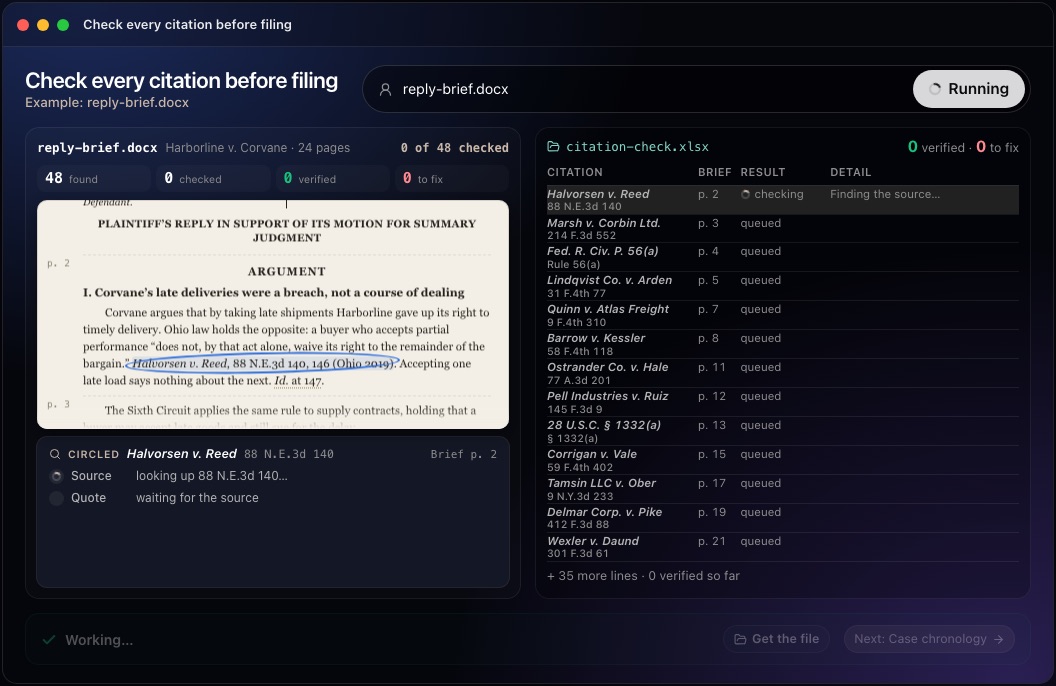
This step in the 10folds window. Example data from the animation on the home page. Check existence, details, quotes and pin cites
One added word in a quotation changes what the court said.
What to do
- Confirm the authority was opened at a source.
- Compare name, court, year, reporter, volume and page with the source, and list each difference.
- Compare every quoted word with the source and show the differences word by word.
- Treat an ellipsis or bracket that changes the meaning as an error.
- Confirm the pin cite page or paragraph contains the passage relied on.
Why
Quotation accuracy and pin cites are where careful briefs most often slip, usually through an edit made after the quote was first pasted. These checks are mechanical, which is exactly why they need to be done every time.
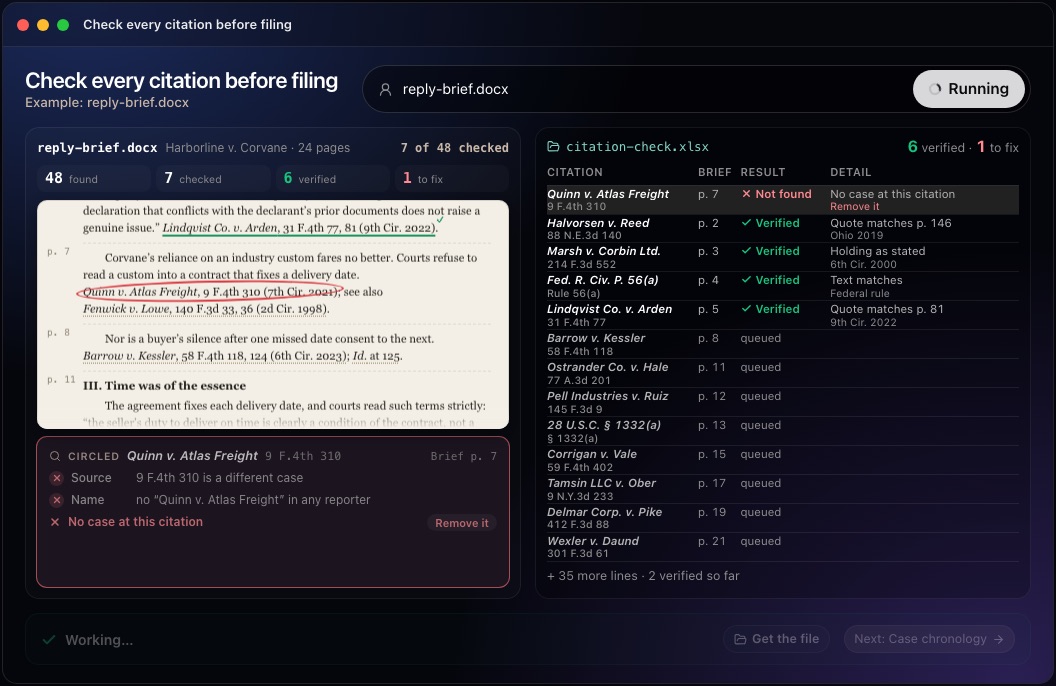
This step in the 10folds window. Example data from the animation on the home page. Check support and whether it is still good law
A real case that says something else is as dangerous as a case that does not exist.
What to do
- Read the passage and decide: supports, partly supports, does not support or contradicts.
- Treat dicta presented as a holding, a dissent cited as the court's view, or a rule from another jurisdiction as partial support at best.
- Run the authority through a citator to see later history, and note what you used.
- Decide whether each unsupported legal statement needs an authority.
Why
Existence checks catch invented citations. Support checks catch the more common problem: a real authority stretched past what it holds. Good law matters just as much, because a reversed or repealed source can sink an argument that reads well.
Report the problems first and fix them from the source
Put the three citations to fix where the lawyer sees them first.
What to do
- Give each citation one verdict: verified, needs attention, problem or could not check.
- Put the problems at the top, each with the sentence and the source passage side by side.
- Write a suggested fix taken from the source: the corrected citation or quote.
- Never propose a replacement authority you have not opened and checked like the others.
- Hand the record to the supervising attorney for review and sign-off.
Why
A cite check is only useful if the attorney can act on it before the deadline. Leading with the problems and showing the evidence beside each one makes the review fast and the fixes safe.
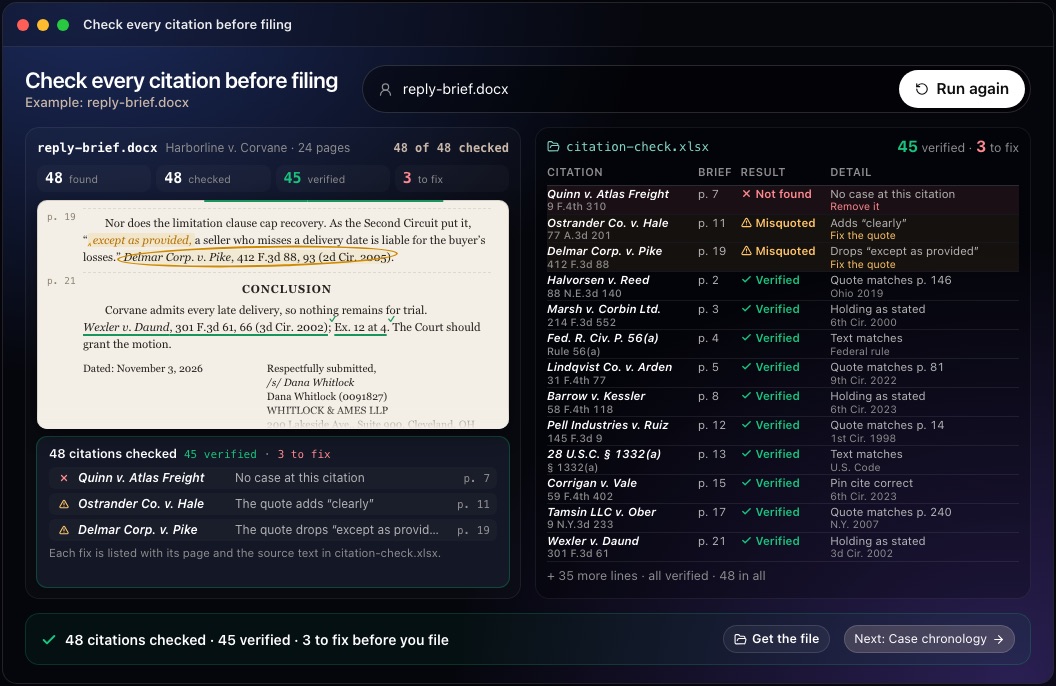
This step in the 10folds window. Example data from the animation on the home page.
Common mistakes
- Trusting the tool that wrote the citationAsk the source, never the system that produced the draft.
- Checking only that the case existsA real case cited for something it does not hold is still a problem.
- Skipping short forms and string citesId., supra and the third case in a string are where errors hide.
- Treating not found as does not existRecord the sources searched and let the lawyer decide.
- Checking before the last editQuotes and pin cites move when text is cut. Check the version you will file.
What a good result looks like
- Every citation numbered, with its sentence, location and proposition.
- Each one tied to a source that was opened, with the date read.
- Quote differences shown word by word.
- One verdict per citation, problems listed first with a fix taken from the source.
- A clear list of what could not be checked, and why.
And then what? Using the result
- Fix the problems first, then the citations that need attention.
- Run a citator on every authority before filing, since this check does not use one.
- Send the corrected draft back for a check of the changed citations.
- Keep the report with the filing record for the supervising attorney.
- Build the case chronology next if the facts section still needs sourcing.
When to run it
- Before every filingRun it on the final draft, after the last substantive edit, so the check matches what the court will read.
- When AI drafted part of the textAny citation produced by a drafting tool should be opened at its source before anyone relies on it.
- When reviewing a colleague's or co-counsel's draftThe table shows where the risk is without re-reading every authority yourself.
- After a late round of editsCuts and rewrites shift quotes and pin cites. A second check covers only what changed.
Questions people ask
What is cite checking?
Cite checking is confirming, before filing, that every authority in a brief exists, is cited correctly, is quoted exactly and supports the sentence that relies on it. It also covers whether the authority is still good law.
How do you verify citations in a legal brief?
Open each authority at an official or trusted source, compare the citation details and every quoted word with it, read the passage at the pin cite, and decide whether it supports the proposition. Record the source and the result for each one.
How do you check AI-generated legal citations?
Open each one in a primary source yourself; never ask the tool that produced it to confirm it. Check that the case exists at that citation, that the quote appears in it, and that it holds what the draft says.
What does a cite check cover?
Existence, citation details, quotation accuracy, the pin cite, whether the source supports the sentence, and later history. Format rules for the court are a separate pass.
Does 10folds replace a citator?
No. It has no citator connection, so later history is reported only where the source itself shows it, and the report says so. Run a citator before filing.
Is the result legal advice?
No. The report is a draft for a qualified lawyer to review. The lawyer decides what to change and whether to file.
More jobs in Lawyers
Check every citation before filing, on your own Mac.Free app. Runs on your Mac with the Claude or Codex plan you already have. Your files stay on your computer.
Download for Mac