
Instagram profile scraping: how to find creators and prospects in a niche
Instagram profile scraping done carefully: define the niche, collect public profile fields with links, qualify each account and use contacts lawfully.
Free app. Runs on your Mac with the Claude or Codex plan you already have.
What Instagram profile scraping is
Instagram profile scraping is the work of building a table of public accounts that match a niche: handle, name, bio, follower count, website and any business email the account publishes. Brands use it for influencer research, and service businesses use it to find prospects who sell through Instagram. The hard part is deciding which accounts truly fit and handling their contact details within the law, which matters more than collecting thousands of handles.
The method below is how a careful marketing researcher does it by hand. Each step says what to do and why, then how 10folds carries it out.
What it does for the business
- Find creators your buyers already followA qualified list of accounts in your niche and area gives a partnership shortlist built on fit, so outreach goes to people whose audience matches yours.
- Reach businesses that sell on InstagramMany small businesses, from designers to bakeries, use Instagram as their shop window. A list of them is a prospect list for anyone who serves those businesses.
- Size a niche before you commitCounting the active accounts that match your criteria in a city shows whether a niche is crowded or open before you spend on a campaign. Treat the count as a floor, since no public route finds every account.
- Keep outreach personalA bio, a website and recent activity on each row give the context for a message that refers to the person's actual work. People answer messages that show you looked at what they do, and ignore the ones that could have gone to anyone.
Instagram profile scraping, step by step
Describe the account you are looking for
A follower range is a filter; the description is the target.
What to do
- Write who they are in plain words, for example interior designers who run their own studio.
- Name the place, if it matters: a city, a region or a country.
- Set a follower range that fits your purpose, such as 5,000 to 200,000.
- Write what you will do with the list: partnership, sales outreach or market sizing.
Why
The purpose decides everything after it. Influencer research needs engaged audiences, sales prospecting needs businesses that can buy, and market sizing needs coverage. A follower range alone admits shops, fan pages and inactive accounts that share a keyword with your niche. Writing the description first also gives you a rule to check each account against later, so two people qualifying the same list reach the same answer.
Find candidates through public routes
Search the way your customers browse, then check every account you find.
What to do
- Start from niche hashtags, location tags and the accounts that leading names in the niche follow or tag.
- Add accounts from public directories, press lists and award pages in your field.
- If you run a business account, check what the Instagram Graph API lets you look up about other business and creator accounts.
- Read Instagram's terms of service and robots.txt, and respect rate limits.
Why
No single route finds every account, and Instagram's search shows each user a different selection. Mixing sources gives a broader candidate list, and accounts that appear through two routes are usually stronger fits. Instagram restricts automated access, so whatever Instagram profile scraper you use, go slowly, stay on public pages and stop at sign-in walls. Tools that ask for your login or a session cookie put your own account at risk and break the platform's rules.
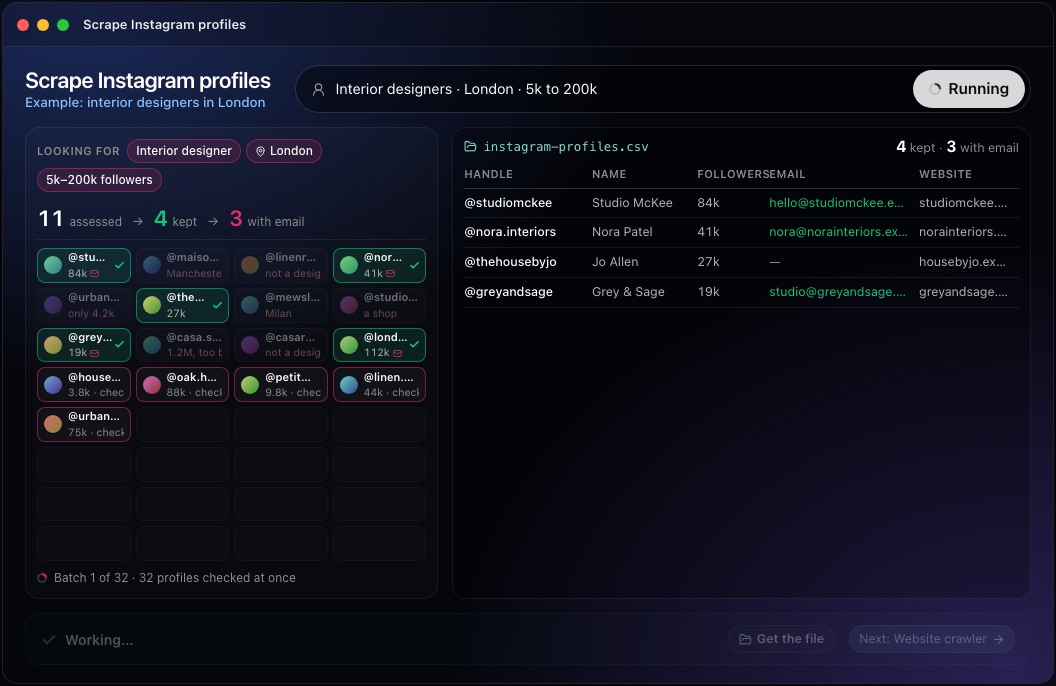
This step in the 10folds window. Example data from the animation on the home page. Collect public profile fields with a link
Collect what the account chose to show, and nothing more.
What to do
- Record handle, display name, bio, follower count, post count and the website link.
- Record a business email or phone only where the account publishes it for contact.
- Keep the profile link and the date you saw it on every row.
- Leave out followers lists, private accounts and personal details found elsewhere.
Why
Under GDPR and similar laws, a name, a handle and an email are personal data even when they are public. Collecting only what the account published for business contact keeps the list defensible, and the law also expects you to keep it no longer than you need it. Follower counts change daily, so the observation date matters when you compare accounts. The website link is often the most useful field: it leads to the business itself, its services and its own contact page.
Qualify every account
Ten accounts that fit beat a thousand that match a keyword.
What to do
- Check that the bio and recent posts match your description, not just a word in it.
- Check activity: when did the account last post.
- Look for signs of bought followers, such as very low engagement for the follower count.
- Remove duplicates by handle, and drop accounts outside your place or follower range with a reason.
- Open a sample of kept and rejected accounts to check the rules are working.
Why
Keyword matches bring in shops, aggregators and accounts in other cities. Dormant accounts and accounts with bought followers look good on paper and do nothing for a campaign. A short reason on every rejected account lets someone else check the judgement. Location is the field most often wrong: many accounts never state a city, so treat a missing place as unknown and check the bio, the website or recent posts before you drop or keep the account.
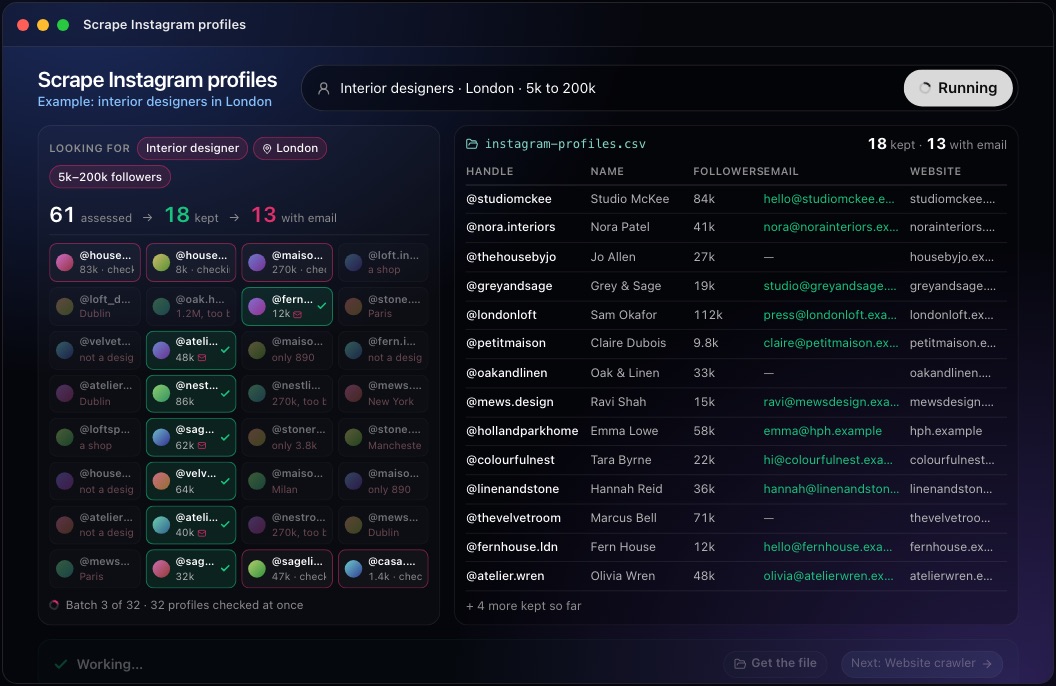
This step in the 10folds window. Example data from the animation on the home page. Deliver the list and use contacts lawfully
A published email is an invitation to relevant business contact, never to a mailing list.
What to do
- Hand over one row per account, with its profile link, bio, followers, website and published email.
- Mark the accounts with no published contact, so nobody hunts for private details.
- Before emailing, check your lawful basis under GDPR and the rules of CAN-SPAM or your local law.
- Write each first message by hand, and honor any request to stop.
Why
Contacting people whose details you scraped is regulated. In the EU and UK you need a lawful basis, often legitimate interest weighed against the person's expectations, and you must tell them where you got their details. In the US, CAN-SPAM sets rules for commercial email. Personal, relevant messages are both lawful and far more likely to get a reply. Keep a record of who you contacted, when and on what basis, so you can answer anyone who asks how you got their details and remove them at once if they ask.
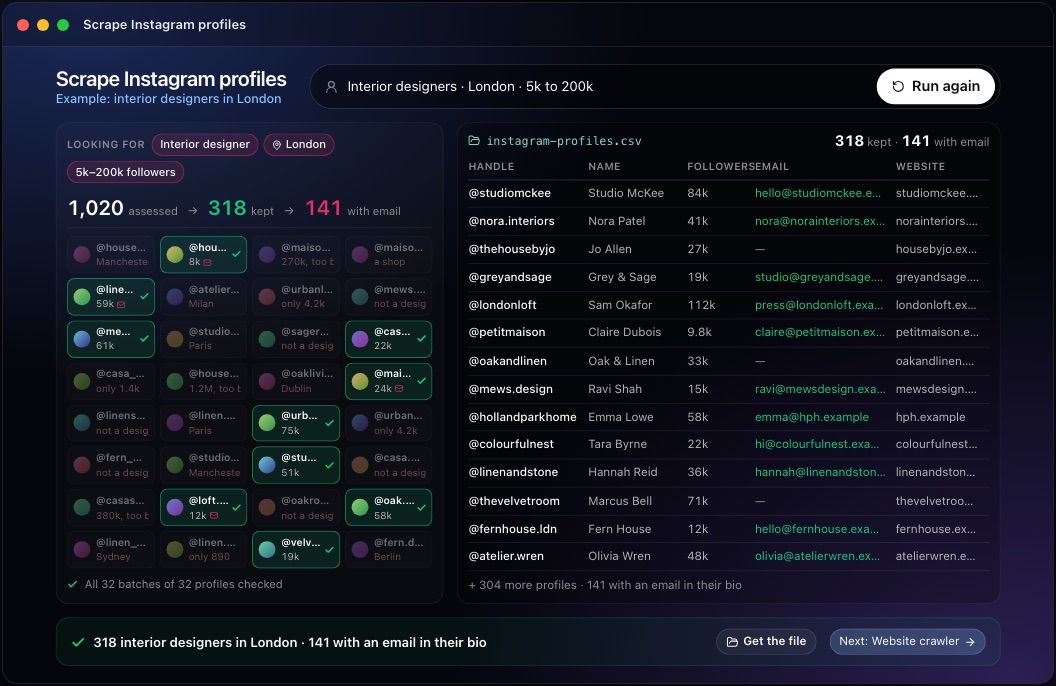
This step in the 10folds window. Example data from the animation on the home page.
Common mistakes
- Judging accounts by follower count aloneFit and engagement matter more than size.
- Collecting personal emails from other sourcesKeep only what the account published for business contact.
- Bulk emailing a scraped listIt breaks privacy and anti-spam rules and damages your sender reputation for every later email you send.
- Logging in to see private accountsPrivate means private. It also breaks the platform's terms.
- Dropping the profile linkWithout it, nobody can check the account or see if it changed.
What a good result looks like
- A one-line description of the target, the place and the follower range.
- One row per account, with its profile link and the date seen.
- Bio, followers, website and a published business email where one exists.
- Rejected accounts listed with a short reason.
- No private accounts and no personal details from other sources.
And then what? Using the result
- Review the top twenty accounts by hand and pick a first shortlist.
- Write a personal first message for each shortlisted account.
- Visit each website to learn what the business sells before you reach out.
- Record replies and opt-outs so nobody is contacted twice.
- Repeat the search in a few months to catch new accounts.
When to run it
- Planning an influencer campaignA qualified list of creators in your niche and area is the shortlist the campaign needs.
- Prospecting businesses that sell on InstagramStudios, shops and makers who use Instagram as their storefront become a list for a sales team.
- Testing a new city or nicheThe number of active, fitting accounts shows how much room there is.
- Refreshing an old creator listAccounts go quiet, change niche or grow out of your budget. Checking an old list against current profiles shows who still fits and who to replace.
Questions people ask
Is it legal to scrape Instagram profiles?
It depends on your country and on what you collect and do with it. Instagram's terms restrict automated collection, and profile data is personal data under laws such as GDPR. Keep to public profiles, collect the minimum and get advice before contacting people at scale.
Can you get emails from Instagram profiles?
Only when the account publishes one, usually in the bio or as a business contact button. The 10folds job saves any email a profile publishes. Contacting that address still needs a lawful basis.
How do you find Instagram influencers in a niche?
Start from niche hashtags, location tags and accounts that established names follow or tag, then qualify each candidate by fit, activity and engagement. Follower count is the last filter, never the first.
What data is on a public Instagram profile?
Handle, display name, bio, profile picture, follower, following and post counts, a website link, and for business accounts often a category and contact button. Audience details and reach are private to the owner.
How many followers should an influencer have?
There is no right number; it depends on the goal. Smaller accounts often have a closer audience and lower fees, while larger ones bring reach. Pick a range that fits your budget, then judge each account on its engagement and on how well its audience matches your buyers.
Does 10folds message the accounts it finds?
No. It saves a table of profiles. Sending messages, and deciding whether to contact anyone at all, remains your decision.
More jobs in Scraping
Scrape Instagram profiles, on your own Mac.Free app. Runs on your Mac with the Claude or Codex plan you already have. Your files stay on your computer.
Download for Mac