
Customer review scraping: how to learn what customers love and complain about
Customer review scraping done carefully: set the scope, collect individual reviews with their links, keep rating scales intact and read themes honestly.
Free app. Runs on your Mac with the Claude or Codex plan you already have.
What customer review scraping is
Customer review scraping is the work of collecting individual public reviews of your products or business, and of your competitors, into one table: rating, text, date, product and a link to each review. Read together, those reviews show what customers value and what frustrates them, in their own words. The value comes from the text and from careful comparison; the average star rating alone tells you little.
The method below is how a market researcher does it by hand. Each step says what to do and why, then how 10folds carries it out. The 10folds job collects and checks a bounded set of public reviews, and its limits are stated in each step.
What it does for the business
- Fix what customers actually complain aboutReviews name the problems people care enough to write about. Grouping them shows which issue comes up most, so effort goes to the fix that matters to customers.
- Find where competitors disappointComplaints about competitors are a map of unmet needs. If buyers of a rival product keep mentioning the same failure, that is a gap your offer and your messaging can address.
- Write marketing in your customers' wordsThe phrases customers use to praise a product are often better copy than anything written in-house, and they match the words future buyers search for.
- Track whether changes workedCollecting the same scope again after a fix shows whether complaints about that issue appear less often in newer reviews.
Customer review scraping, step by step
Define an exact comparison scope
Two products are only comparable if their reviews describe the same thing.
What to do
- Name your product or business and the competitors to compare, with the exact variant or location.
- Name the storefronts or platforms where their reviews appear, and the country.
- Set the period, for example reviews since January of last year.
- Write the decision the review analysis should inform.
Why
Reviews of a different model, a different branch or a different country describe a different experience. A product page that groups several variants can mix their reviews together. Writing the scope down before collecting keeps the comparison fair and makes it repeatable later.
Choose sources and a route that respects them
Reviews belong to the people who wrote them and the platforms that host them.
What to do
- For your own listings, use the owner tools or official APIs the platform offers, such as your Google Business Profile.
- For competitor reviews, read each platform's terms of service and robots.txt.
- Look for review data published as structured data on product pages, which is designed to be read by machines.
- Go slowly, collect public reviews only and stop at any sign-in page or challenge.
Why
Official owner access is stable and allowed, though it covers only your own reviews. Platforms such as Google restrict automated access to other businesses' reviews, so any review scraper that reads competitor pages must stay within those terms. Many retailers publish reviews as Review structured data, a standard format that is easier and safer to read than the visible page.
Collect individual reviews with their links
A quote you cannot trace back is a quote you cannot use.
What to do
- Record the review text, the rating and its scale, the date, the product variant and the review's own link or ID.
- Record the owner's reply if there is one.
- Keep reviewer names only if your purpose needs them, since they are personal data under GDPR.
- Note the order the platform used, such as most relevant or newest.
Why
Each review's link lets anyone check a quote in context. A rating without its scale is ambiguous: four out of five and four out of ten mean different things. Platforms often sort Google reviews and others by relevance by default, which favors certain reviews, so the order you collected in shapes what you saw.
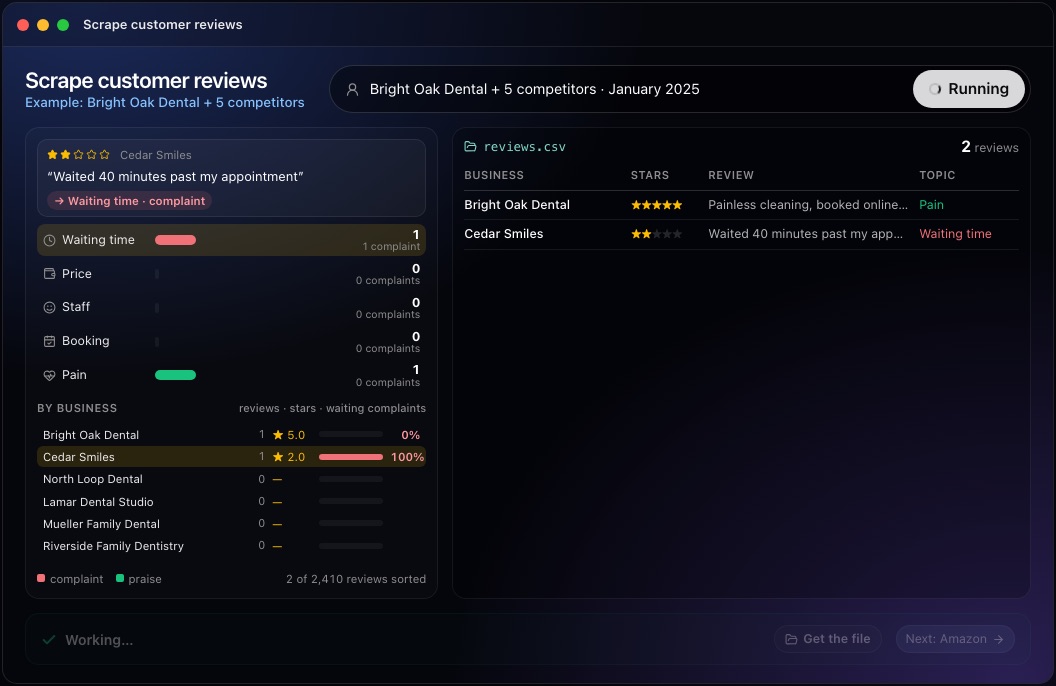
This step in the 10folds window. Example data from the animation on the home page. Clean and filter without changing the evidence
Clean the table, never the reviews.
What to do
- Remove duplicates: the same review is often syndicated to several retailers.
- Convert ratings to one scale only when the original scale is known.
- Filter to the period, the variant and any terms in your scope.
- Keep the review text exactly as written.
Why
Syndicated reviews counted twice inflate a theme. Converting a rating without its scale invents data. Editing review text, even to fix spelling, makes quotes untrustworthy. An aggregate star rating is a different measure from the individual reviews behind it and should never stand in for them.
Group reviews into themes, and read them honestly
A theme is a pattern across reviewers, never one angry customer.
What to do
- Read a sample first and write a short list of themes, such as waiting time, price, staff, booking and quality.
- Tag each review with its themes and mark each mention as praise or complaint.
- Count how often each theme appears for each product or business, within the same period.
- Pick two or three verbatim quotes per theme as examples.
Why
Sentiment analysis, labeling text as positive or negative, says how people feel but not about what. Themes say what to fix. Reviews come from people motivated to write, so they show what matters to vocal customers, and a single review is an anecdote, never a diagnosis of a product defect.
Deliver with the coverage stated
Say what you could not read before you say what you found.
What to do
- Open a few top rows and check them against the original pages.
- State in one line what was collected and the main gap.
- List pages that were blocked, rate-limited or unsupported.
- Name the next action, such as fixing the top complaint or testing a new message.
Why
A competitor with no complaints in your table may simply have had its reviews blocked. Stating coverage first stops a missing source from turning into a false conclusion. A clear next action turns the analysis into a decision.
Common mistakes
- Relying on the average star ratingIt hides what people praise and what they complain about.
- Mixing variants, branches or countriesCompare the same product in the same market.
- Counting syndicated reviews twiceDeduplicate before counting themes.
- Treating one review as a defect reportLook for the same issue across several reviewers.
- Reading blocked pages as happy customersCheck coverage before comparing competitors.
What a good result looks like
- A one-line scope: products, storefronts, market and period.
- One row per review, with its text, rating and scale, date and link.
- Themes counted per product, each with real quotes.
- Ratings converted only where the scale is known.
- A list of sources that could not be read.
And then what? Using the result
- Take the most frequent complaint to the team that can fix it.
- Use competitors' most frequent complaint in your positioning, where you do better.
- Lift customers' own phrases into your product page and ads.
- Reply to unanswered negative reviews on your own listings.
- Run the same scope again after a change and compare.
When to run it
- Before a product or service changeReviews show which problems customers mention most, so the change targets the right one.
- When entering a market with established rivalsComplaints about incumbents show what buyers wish someone did better.
- When writing positioning or ad copyCustomers' own words for what they value make clearer, more credible messages.
- After fixing a known issueA repeat collection shows whether new reviews still mention it.
Questions people ask
Is it legal to scrape reviews?
It depends on the platform's terms, your country and what you do with the data. Review text and reviewer names can be personal data under GDPR, and republishing reviews raises copyright questions. Analyzing public reviews for internal research is the lower-risk use; get advice for anything more.
Can you scrape Google reviews?
Google offers owners access to their own reviews through the Google Business Profile tools. Its terms restrict automated collection of other businesses' reviews from Maps. The 10folds job reads public review pages and structured data you supply, and it does not log in or bypass blocks.
How do you analyze customer reviews?
Read a sample, write a short list of themes, tag every review with its themes as praise or complaint, then count each theme per product within the same period. Support each finding with real quotes.
How many reviews do you need for analysis?
There is no fixed number. You need enough that each theme you report rests on several independent reviewers, within the same product, market and period. With few reviews, report quotes and avoid percentages.
How many reviews does the customer review scraping job collect?
Up to 25 public sources and 100 records by default, with a hard maximum of 1,000. It does not promise every review on a platform. Figures in the example screens on this site are illustrative.
Does it reply to reviews?
No. It reads public pages and writes files in your project folder. It does not post, reply or contact sellers or reviewers.
More jobs in Scraping
Scrape customer reviews, on your own Mac.Free app. Runs on your Mac with the Claude or Codex plan you already have. Your files stay on your computer.
Download for Mac