
How to respond to an RFP, requirement by requirement
How to respond to an RFP: decide whether to bid, list every requirement, answer each one from evidence and show the gaps before the deadline.
Free app. Runs on your Mac with the Claude or Codex plan you already have.
What responding to an RFP involves
Knowing how to respond to an RFP, a request for proposal, means answering a buyer's written list of requirements completely, in their order, with evidence they can score. An RFP response is rarely lost on writing style. It is lost on the requirement nobody answered, the claim nobody could back up, or the certificate that turned out to be expired.
It applies to public tenders and private requests alike. The method below is how an experienced bid or proposal manager runs a response by hand. Each step says what to do and why, then how 10folds carries it out.
What it does for the business
- Answer more RFPs with the same teamMost questions in an RFP have been answered before, in past proposals and policies. Drafting from those documents leaves the team to spend its time on the few questions that are new. It also keeps answers consistent from one RFP to the next.
- Lose fewer bids on complianceEvaluators often discard responses that miss a mandatory requirement. A requirement-by-requirement matrix makes a missing answer visible before submission.
- Make claims you can defendEvery answer tied to a source can be checked by your team and by the buyer. Nothing goes in that a later contract or audit would contradict.
- See the hard questions earlyGaps found in the first days can often be closed: a reference requested, a certificate renewed, a clarification asked. Found at the deadline, they cannot. The list of gaps also tells you whether the bid is still worth finishing.
How to respond to an RFP, step by step
Make the go/no-go decision
The cheapest RFP to lose is the one you decided not to answer.
What to do
- Read the whole RFP once, start to finish, before deciding anything.
- Check the mandatory conditions: certificates, insurance, turnover, references, location.
- Judge fit: does the scope match what you deliver, and do you know the buyer?
- Check capacity: who will write, review and approve it before the deadline.
- Record the go/no-go decision and the reason, so the next one is faster.
Why
Responding takes days of skilled time, and an RFP written around a competitor's product is hard to win. A short, honest decision protects that time for the bids you can win. Many teams also set a rule of thumb, such as bidding only when they know the buyer or helped shape the requirements.
Build the compliance matrix
If the buyer numbered it, you answer it.
What to do
- List every requirement and question with its original number and exact wording.
- Split compound questions into parts, keeping the link to the original number.
- Note the evaluation criteria and weights, the format rules, page limits and deadlines.
- Assign each requirement to an owner among your subject matter experts.
Why
A compliance matrix is a table with one row per requirement, showing where and how each is answered. Evaluators score against their own list, so a matrix in their order makes your response easy to score and makes omissions impossible to miss. Owners named early know what they must supply and by when.
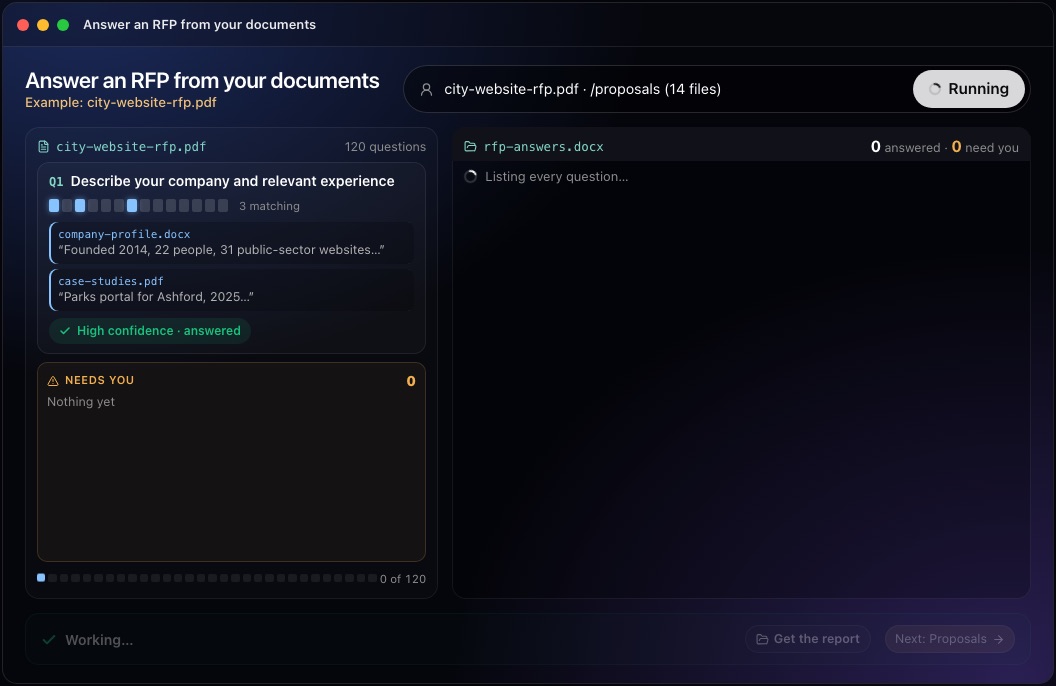
This step in the 10folds window. Example data from the animation on the home page. Find the evidence for each answer
A named customer, a figure or a certificate scores. A claim to be leading does not.
What to do
- Search your content library: past proposals, security and privacy policies, case studies, certificates, product documents.
- For each requirement, record the document and passage that supports the answer, and its date.
- Classify each one: fully supported, partly supported, not supported or unknown.
- Check dates. An expired certificate or an old policy is a gap, not evidence.
- Note where two documents disagree, and ask the owner which one is current.
Why
Evaluators look for proof. Unknown and unsupported are different: unknown means nobody has checked, unsupported means you cannot do it. Treating unknown as a yes is how responses promise things the company cannot deliver. A dated source also shows when an answer needs refreshing.
Write the answers
Answer the question asked, then prove it, then stop.
What to do
- Answer each requirement directly in the first sentence, then give the evidence.
- State partial compliance plainly, with its limit and any workaround.
- Write the executive summary last: the buyer's problem, your answer to it, and why you.
- List clarification questions for the buyer, and send them before the question deadline.
- Keep wording consistent with your approved content.
Why
Direct answers are easier to score and harder to misread. An honest partial answer is safer than a vague full one, because the buyer will find the limit during delivery. Clarification questions asked early can change a requirement in your favor, and buyers usually share the answers with every bidder.
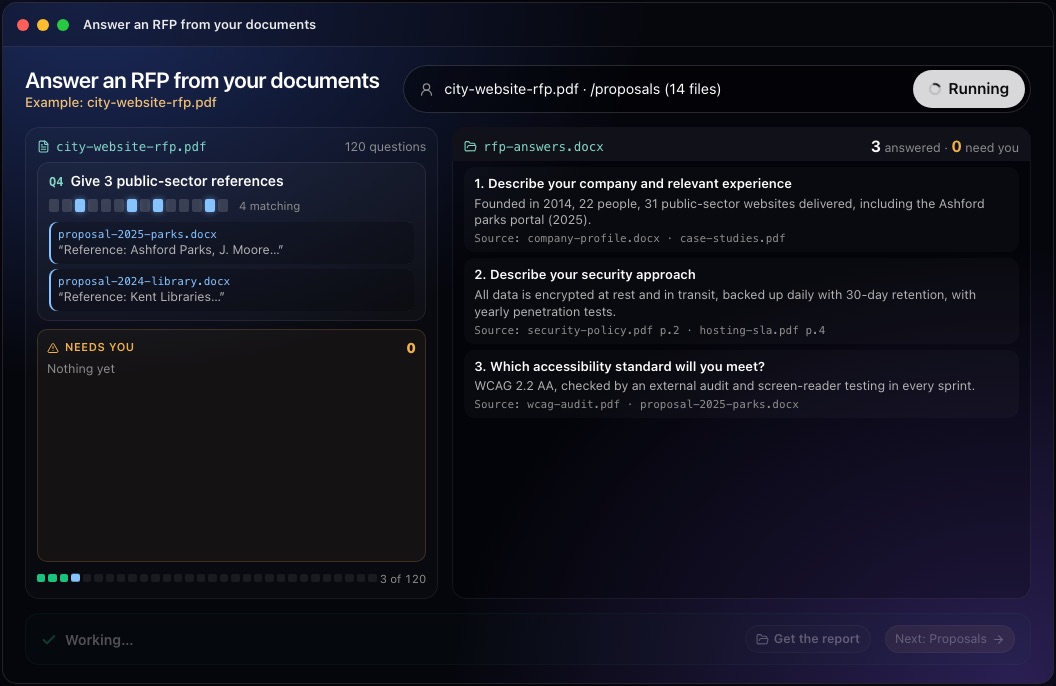
This step in the 10folds window. Example data from the animation on the home page. Review, close the gaps and submit
Every sentence in a response is a promise someone will hold you to.
What to do
- Have someone who did not write the answers check each claim against its source.
- Send the gaps to their owners: prices, named staff, insurance, signed declarations.
- Check the response against the format rules, the page limits and the submission instructions.
- Submit early, and keep confirmation of receipt.
Why
Writers miss their own unsupported claims. A separate reviewer catches them, and an early submission leaves room for a portal failure or a last clarification. Check that the response matches the final version of the RFP, since buyers publish amendments.
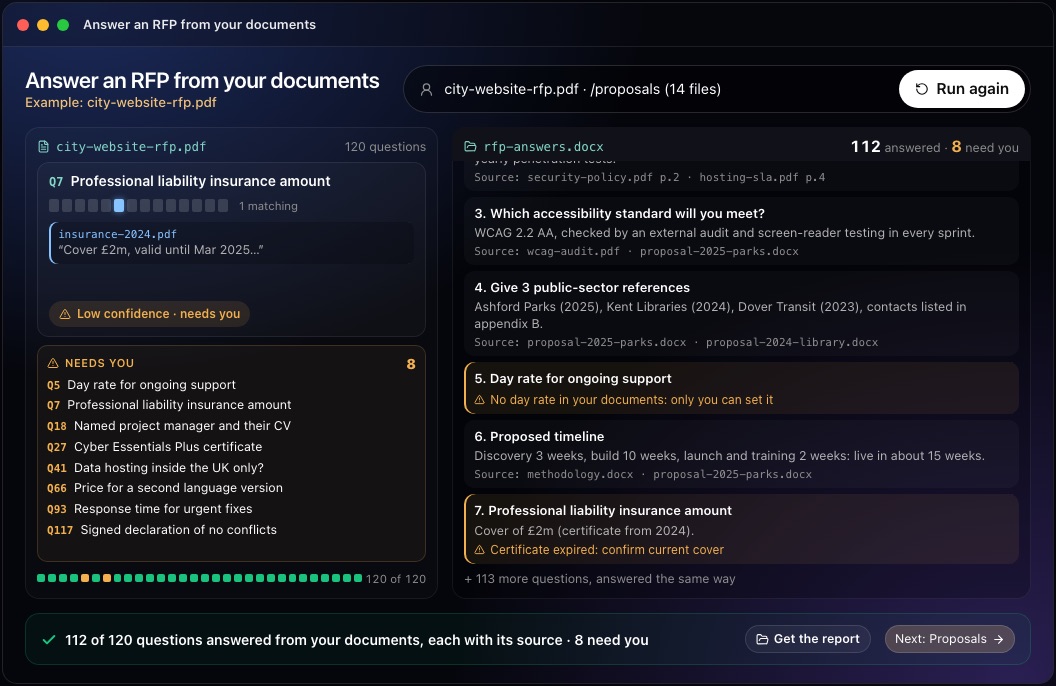
This step in the 10folds window. Example data from the animation on the home page.
Common mistakes
- Answering every RFPWithout a go/no-go decision, effort goes to bids you cannot win.
- Changing the buyer's structureEvaluators score in their order; keep their numbering.
- Adjectives instead of evidenceReplace claims of quality with a reference, a figure or a document.
- Treating unknown as yesCheck with the owner before promising a capability.
- Finding gaps at the deadlineList them on day one, while they can still be closed.
What a good result looks like
- Every requirement appears once, in the buyer's order and numbering.
- Each answer cites a document or is marked as a gap.
- Partial answers state their limit.
- A short list of questions only you can answer, with owners.
- An executive summary written around the buyer's problem.
And then what? Using the result
- Answer the flagged questions: price, named staff, commitments.
- Send clarification questions to the buyer before the question deadline.
- Ask the owners of expired or missing documents to renew or supply them.
- Save the approved answers to your content library for the next RFP.
- After the award, ask the buyer for feedback on your scores.
When to run it
- When an RFP lands with a short deadlineA first draft from your documents leaves the remaining days for the new questions and the price.
- When the same questions keep coming backSecurity, privacy and company questions repeat across RFPs; answering them from approved sources keeps the answers consistent.
- Before committing to bidA first pass shows how much of the RFP your documents already cover and where the hard gaps are.
- After choosing a public tender to bid forOnce a tender is marked worth a bid, the response starts from the same documents, with every requirement accounted for and the gaps listed for their owners.
Questions people ask
How to respond to an RFP with a small team?
Make a strict go/no-go decision, build a compliance matrix on day one, and draft from past proposals and policies so experts only write what is new. Assign one owner per gap, and submit a day early. Keep a shared tracker of owners and dates, and stop writing new content on the last day so there is time to review.
What is a compliance matrix?
A compliance matrix is a table with one row per requirement in the RFP, showing whether you comply and where the answer is in your response. It makes omissions visible to you and makes scoring easy for the buyer. Some buyers supply their own matrix; when they do, fill in theirs exactly.
Should you respond to every RFP?
No. Respond when you meet the mandatory conditions, the scope fits what you deliver, you have a realistic chance and the team has time to write a strong answer. Declining weak fits frees time for the bids you can win. A written record of past decisions makes the next one quicker.
What goes in an RFP executive summary?
A short statement of the buyer's problem in their words, your proposed answer, the outcomes they can expect and the main reasons to choose you, with evidence. Write it last, once the answers are settled.
What if you cannot meet a requirement?
Say so clearly, explain any partial alternative, and check whether the requirement is mandatory. If it is mandatory and you cannot meet it, the go/no-go decision should usually be no. Ask a clarification question if the wording is unclear. Do not hide a gap in vague wording; evaluators look for it.
Will 10folds submit the response or set the price?
No. It drafts answers from your documents and marks what only you can decide. Pricing and commitments stay with you, and nothing is submitted or sent.
More jobs in Sales & outbound
Answer an RFP from your documents, on your own Mac.Free app. Runs on your Mac with the Claude or Codex plan you already have. Your files stay on your computer.
Download for Mac