
Content repurposing: turn one article into a campaign
A content repurposing method: pick the strongest ideas in one article, turn them into posts, an email and a video script, and keep every claim sourced.
Free app. Runs on your Mac with the Claude or Codex plan you already have.
What content repurposing is
Content repurposing is the work of turning one substantial piece, such as an article, guide or webinar, into several smaller pieces for other channels: social posts, an email, a short video. Each new piece takes one idea from the original, reshapes it for its channel and points back to it. Done well, a single article feeds a week or more of useful content. Done badly, it produces copies of the same paragraph that drift further from the facts with every rewrite.
The same method works for a webinar transcript, a guide or a long case study. What matters is that the source is accurate, because every new piece inherits its facts. Each piece should also stand on its own for a reader who never sees the article, and the pieces work best spread over a week or two. The method below is how an experienced content marketer turns one article into a campaign by hand. Each step says what to do and why, then how 10folds carries it out.
What it does for the business
- A week of content from one pieceThe research and thinking are already done. Repurposing spreads that work across channels instead of starting each post from nothing. Your time goes into reviewing, not starting over.
- Reach people where they areSome readers never open a blog but read email; others only watch short video. Several formats carry the same idea to all of them. Each format points back to the full article for those who want more.
- Stay on messageWhen every post, email and script comes from one article, the campaign says the same thing everywhere, and the facts match. Readers who meet the campaign on two channels hear one consistent story.
- More life for evergreen contentAn article that stays true for months can be brought back to readers again and again, each time in a new form. Each new format reaches people who missed it the first time.
Content repurposing, step by step
Choose the source, the audience and the action
A campaign needs one reader and one thing you want that reader to do.
What to do
- Pick an article that is accurate, current and already useful, often evergreen content that performed well.
- Name the audience the campaign is for.
- Choose one call to action: read the guide, book, sign up.
- Decide the channels and the language before writing anything.
- Set a rough schedule so the pieces go out over a week or two.
Why
Repurposing magnifies whatever is in the source, including its errors. A clear audience and single action keep the separate pieces working together. Deciding the channels early also tells you which formats to write, so no time goes into pieces nobody will publish.
Map the claims and pick distinct angles
Find the three ideas that each deserve their own piece.
What to do
- List the reusable facts, advice, quotes and links, noting where each appears in the article.
- Check that offers, prices and links are still current.
- Separate the author's opinion from measured facts, and note anything that must not be repeated.
- Choose three different angles, such as a checklist, a problem and its solution, and one key takeaway.
Why
A claim map makes every later piece easy to check. Distinct angles stop the campaign from saying the same thing five times, which tires the people who follow you on several channels. Noting restrictions early also prevents quoting a client or partner in a way they did not agree to.
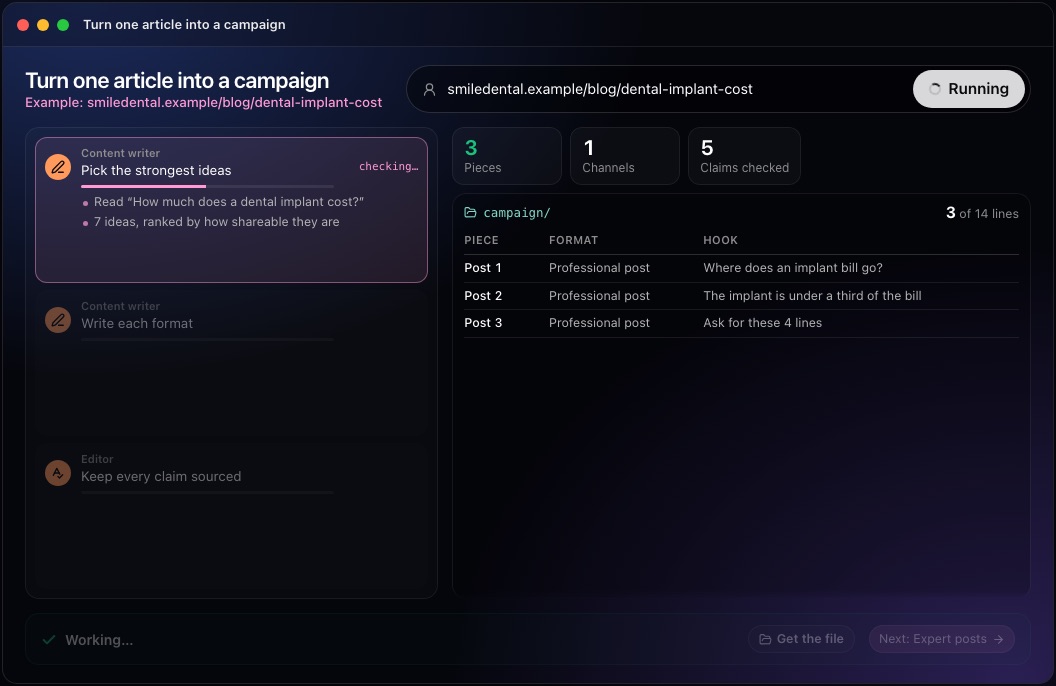
This step in the 10folds window. Example data from the animation on the home page. Write the social posts and the email
Reshape the idea for the channel; keep the facts exactly as they were.
What to do
- Write one post per angle, such as a LinkedIn post or a carousel, each opening with a hook and ending with the action.
- Add a short image brief and alt text where the post needs a visual.
- Write an email newsletter with two subject line options, a preview line, the body and one call to action.
- Link every post and the email back to the article.
Why
Each channel rewards a different length and opening, so the words must change. The facts must not, and a single call to action makes the campaign's purpose clear. Image briefs and alt text written now also save a round of questions when someone makes the visuals.
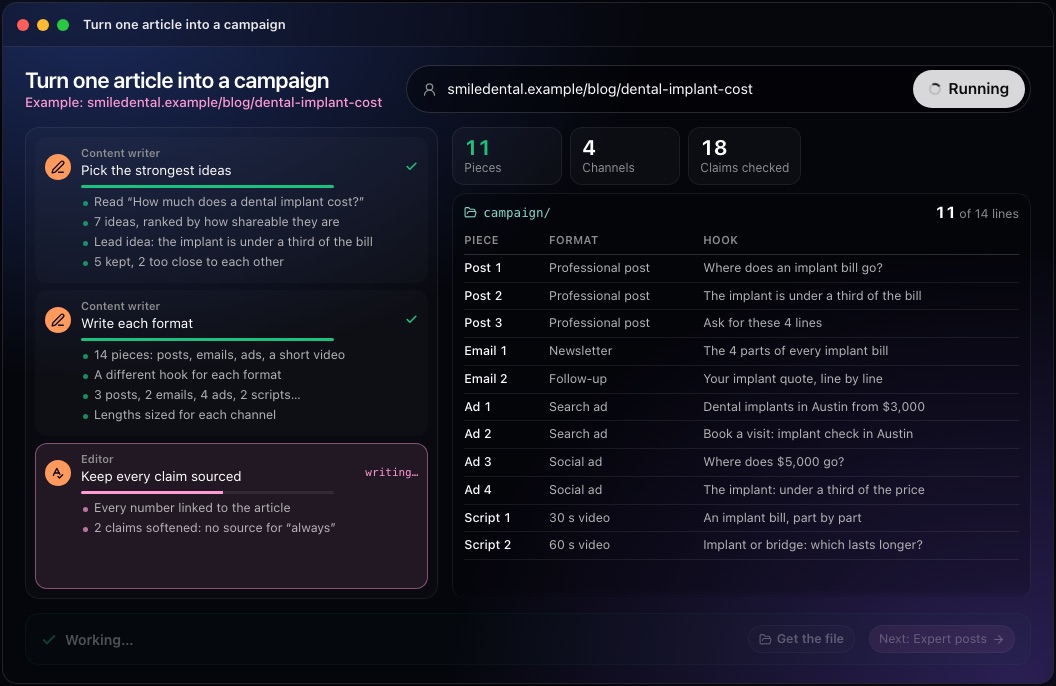
This step in the 10folds window. Example data from the animation on the home page. Write a short video script
Time a script by its words, not by how it feels when you read it.
What to do
- Aim for 45 to 60 seconds, enough for one idea.
- Open with the hook in the first seconds and close with the action.
- Write the spoken lines with timestamps, plus the visuals and on-screen text for each.
- Estimate length from the word count at a normal speaking pace.
- Keep the facts identical to those in the posts and email.
Why
Short video works for one clear idea. Timing it from the word count prevents a script that runs long once someone reads it aloud. Visual cues written next to each line also help whoever films or edits to match the words.
Check every piece against the source
A repurposed claim must still mean what the original said.
What to do
- Have someone else read each piece next to the article.
- Check that qualifications survived: “often” must not become “always”.
- Confirm that the call to action and links match across all pieces.
- Remove any performance claim the article does not support.
- Check every link opens and leads to the intended page.
Why
Each rewrite is a chance for a fact to drift. A final side-by-side check catches overstated claims before they reach several channels at once. It is also the moment to confirm that every link still works and leads where the campaign promises.
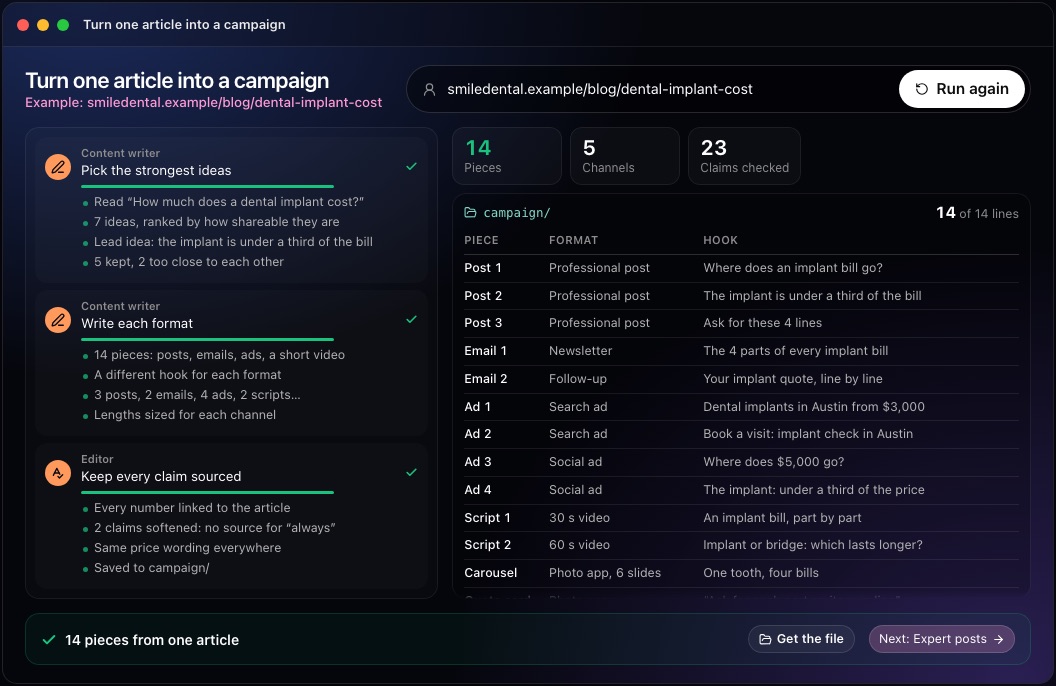
This step in the 10folds window. Example data from the animation on the home page.
Common mistakes
- Repurposing a weak articleSpreading a thin piece across channels spreads the thinness.
- Same angle in every formatFollowers on two channels see the same post twice.
- Losing the qualifications“Often” turned into “always” is a new and false claim.
- Several calls to actionA campaign with three different asks gets none of them.
- Guessing video lengthCount the words; scripts read aloud run longer than expected.
What a good result looks like
- One source, one audience, one call to action.
- A claim map with where each fact sits in the article.
- Three posts with genuinely different angles.
- An email with subject options, preview and one action.
- A timed 45 to 60 second script, every piece checked against the source.
And then what? Using the result
- Edit the drafts so they sound like you.
- Set up the sender and opt-out details before the email goes out.
- Spread the posts over a week or two in your calendar.
- Record the video from the script, or hand it to whoever films.
- Note which angle drew the most replies and use it for the next article.
When to run it
- After publishing an important articleA campaign makes sure the people who follow you on other channels hear about it. Start the same week, while the article is new.
- When an old guide still performsRepurposing brings evergreen content back to readers without writing anything new. Check its facts and offers are still current first.
- When channels go quietOne good source can keep social, email and video active for a week. Plan the pieces over the quiet period in one sitting.
- Before a launch or seasonal pushRepurposing a strong related article gives you ready material for every channel at once. The facts and the call to action stay aligned across channels.
Questions people ask
What is content repurposing?
Content repurposing is reshaping one substantial piece, such as an article or webinar, into smaller pieces for other channels, like posts, emails and short videos, each pointing back to the original. It saves the research and thinking already done for the original piece.
How do you repurpose a blog post?
List its key facts and ideas, choose a few distinct angles, write a post per angle, an email and a short video script, link them all back, and check each against the article. Spread the pieces over a week or two rather than publishing them all on the same day.
What content should you repurpose?
Your strongest, most current pieces: guides that answer real customer questions, articles that performed well and evergreen content that stays true for months. Avoid anything out of date or tied to an offer that has ended.
How many pieces can you make from one article?
As many as it has distinct, useful ideas. A typical starting set is three social posts, one email and one short video script. Fewer, distinct pieces work better than many that repeat each other.
Does 10folds post or send anything?
No. It writes drafts. Nothing is published, sent or scheduled, and the email's sender and opt-out settings are left for you to configure. You review and publish each piece in your own tools.
Can I give it a webinar instead of an article?
Yes. The source can be an article or a transcript. For transcripts, facts are located by timestamp. The same checks apply: every derived claim is tied back to its place in the source.
More jobs in Marketing
Turn one article into a campaign, on your own Mac.Free app. Runs on your Mac with the Claude or Codex plan you already have. Your files stay on your computer.
Download for Mac