
Private blog network: how it works, the risks and safer options
A private blog network is a set of sites built to link to one site. Google treats it as a link scheme. How PBNs work, the risks and the safer options.
Free app. Runs on your Mac with the Claude or Codex plan you already have.
What a private blog network is
A private blog network (PBN) is a group of websites controlled by one person or company and built mainly to link to one main site, often called the money site, so that it ranks higher in search. Many networks are built on expired domains that still carry links from their previous owners. Google's spam policies name this practice directly: links created to manipulate rankings are a link scheme. A site that relies on one can receive a manual action or lose its rankings when the network is detected.
Networks like this spread because they can work for a while: links still count in ranking, and links from sites you control are cheaper than links you earn. They fail for the same reason. Search engines look for groups of sites that exist only to pass links, and when one is found, the penalty lands on the site it was built to help. This page explains how these networks work, why they fail, and how to run a group of sites you own without breaking those rules. It does not present a PBN as a safe practice. Each step also says what the 10folds job does.
What it does for the business
- Reach separate audiences with separate sitesA group of sites, each serving a distinct audience with its own useful content, can reach readers that one broad site would not. Each site builds its own visitors and its own reputation.
- Own more of your trafficSites you control are not exposed to a single platform's rules. Visitors who come for a useful site, and not for its links, stay valuable whatever happens to your main site. That independence is the point of owning more than one site.
- Test topics before committingA small site on a new subject shows whether readers care before you build that subject into your main business.
- Build assets with their own valueA site with real readers and revenue can be kept, grown or sold. A site that exists only to link has no value once its links stop counting.
Private blog network, step by step
Decide whether to build at all
Weigh what you could gain against what your main site could lose.
What to do
- Read the section on link schemes in Google's spam policies before buying anything.
- Write down what would happen to your business if your main site lost its rankings for months.
- Ask, for each planned site, whether it would be worth running if it never linked to you.
- Compare the effort with the alternatives: a stronger main site and white-hat link building.
Why
A private blog network built to pass links can lift rankings for a while. When it is found, the penalty lands on the main site, and recovery means removing or disavowing the links and asking for a review. That risk belongs in the decision from the start. Many site owners discover the problem only when a notice appears in Search Console, long after the links were placed.
Plan sites that serve a real audience
A site with no readers of its own is a link with a domain name attached.
What to do
- Give each site a subject and a reader that exist without your main site.
- Avoid buying expired domains for the links they used to have.
- Plan for each site to earn its own visitors from search, newsletters or communities.
- Write down how each site will be measured on its own.
Why
Expired domains bought for their old links are a common PBN pattern, and repurposing a domain's past reputation to rank unrelated content is itself named in Google's spam policies. A site planned around its readers can survive on its own merits. A site with its own readers also gives you something to show if anyone asks why the link exists: an audience that uses it.
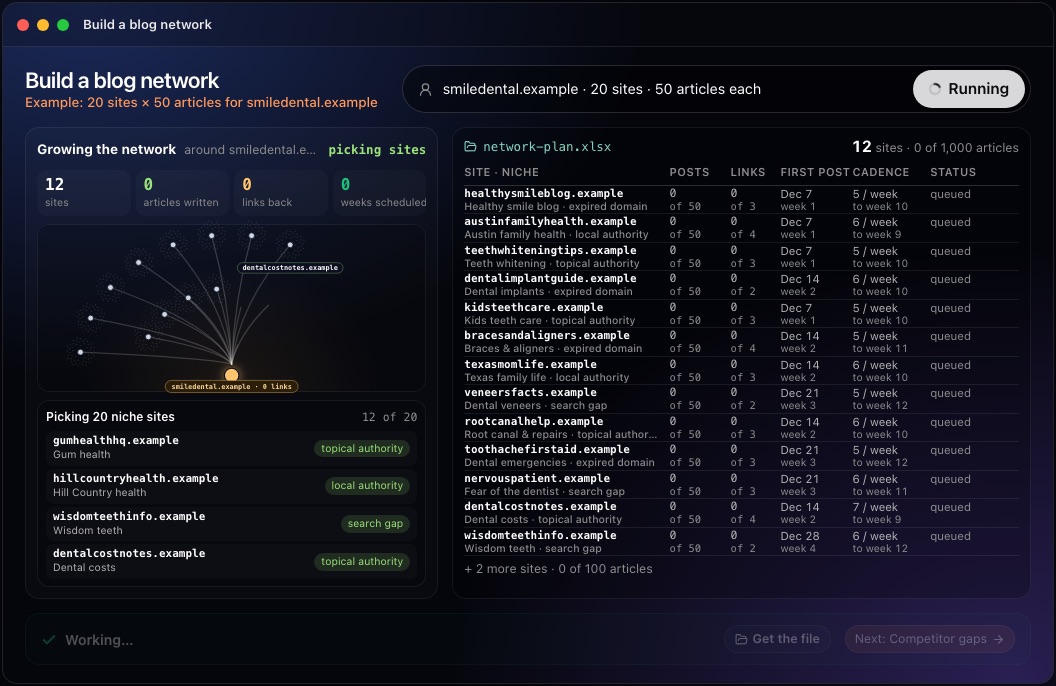
This step in the 10folds window. Example data from the animation on the home page. Write content its readers would come for
If nobody would read it, nobody should publish it.
What to do
- Plan articles from the questions each site's readers actually ask.
- Publish at a pace you can keep to a standard you would sign.
- Have a person review what is published, especially facts and advice.
- Prefer fewer useful articles over many thin ones.
Why
Publishing large numbers of pages made mainly to rank, by people or by AI, is what Google's spam policies call scaled content abuse. Thin articles also fail with readers, so the sites never earn visitors of their own. A review by a person who knows the subject is the simplest test: if they would not put their name to an article, it should not be published.
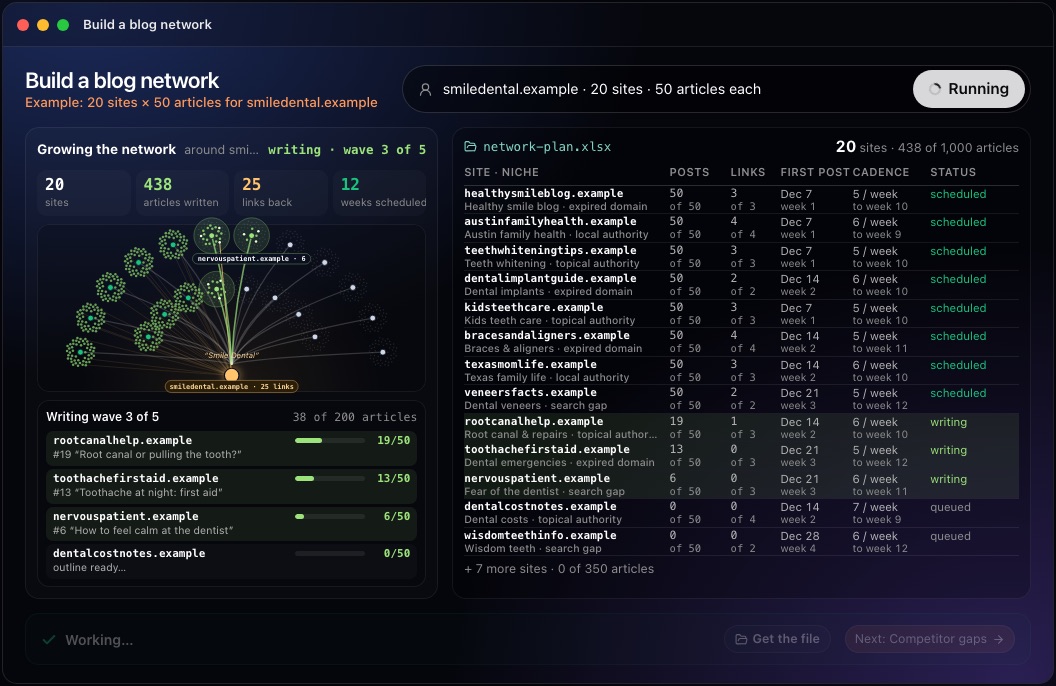
This step in the 10folds window. Example data from the animation on the home page. Link only where it helps, and publish on a schedule
A link should exist because a reader needs the page behind it.
What to do
- Link to your main site only where it truly helps the reader of that article.
- Mark links between sites you own with rel="nofollow", which tells search engines not to pass ranking credit.
- Do not vary anchor text or hide ownership to avoid detection: that does not make a scheme compliant.
- Spread publishing over weeks at a rhythm each site can keep up.
Why
Links placed to pass ranking credit to your own site are a link scheme whatever the anchor text, the spacing or the design. Disclosing the relationship with nofollow removes the manipulation and keeps the link useful to readers. If you are unsure whether a link would pass that test, ask whether you would place it on a site you did not own.
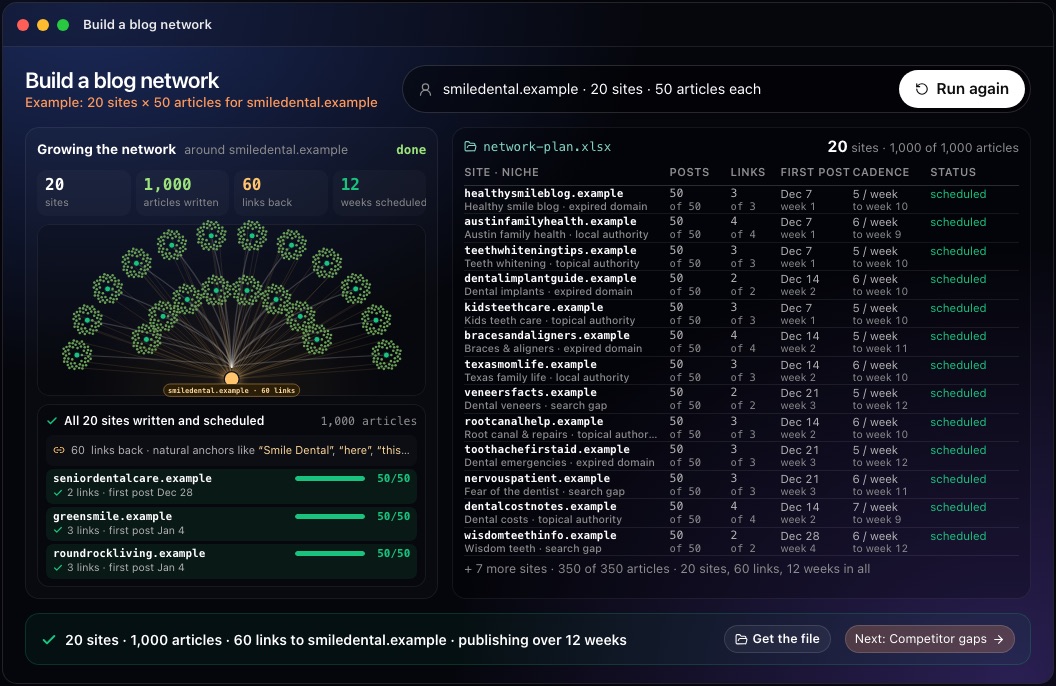
This step in the 10folds window. Example data from the animation on the home page. Measure each site on its own
A site is worth keeping if its readers would miss it.
What to do
- Track each site's own visitors, sign-ups and revenue in your analytics.
- Check Search Console for each site, including the Manual actions report.
- Close or merge sites that do not earn readers after a fair period.
- Watch your main site's Search Console for a manual action notice.
Why
A network measured only by the rank it gives the main site has no reason to exist when that rank goes away. A site measured by its own readers tells you whether it was worth building.
Common mistakes
- Treating a private network as safeGoogle's spam policies call links built to manipulate rankings a link scheme, private or not, and the result can be a manual action or lost rankings.
- Buying expired domains for their linksUsing an old domain's reputation to rank new, unrelated content is itself a named spam practice.
- Publishing hundreds of thin articlesMass-produced pages made to rank are scaled content abuse, and they earn no readers.
- Hiding the footprintDifferent hosts, themes and anchors may delay detection; they do not make the links compliant.
- Betting the main business on itIf the network is found, the main site carries the penalty.
What a good result looks like
- Each site has a clear subject and reader of its own.
- No domain was bought for its old links.
- Articles a person has reviewed and would sign.
- Links to your own sites only where they help, marked nofollow.
- Each site tracked on its own visitors and checked in Search Console.
And then what? Using the result
- Read Google's spam policies on link schemes, expired domains and scaled content.
- Remove or nofollow links from sites you own that exist only to pass ranking credit.
- Put the effort into white-hat link building: pages worth citing, and outreach to sites that cover your subject.
- Check your main site's Manual actions report in Search Console.
When to run it
- When someone offers you PBN backlinksKnow what they are before you pay. The links point at your site, so the risk is yours.
- When you already own several sitesReview how they link to each other, and mark links that exist to pass ranking credit with nofollow.
- When an earlier agency built links for youCheck whether some come from a network. If you find a manual action, removing or disavowing those links is the first step.
Questions people ask
What is a private blog network?
A private blog network is a group of sites controlled by one owner and built mainly to link to one main site to raise its rankings. Many are built on expired domains that keep links from their past.
Are PBNs against Google's guidelines?
Yes. Google's spam policies treat links created to manipulate rankings as a link scheme. A network built to pass links to your own site is exactly that.
Can a PBN get your site penalized?
Yes. Google can apply a manual action, shown in Search Console's Manual actions report, or stop counting the links, and the main site can lose its rankings. Recovery means removing or disavowing the links and, for a manual action, requesting a review. The links may also simply stop counting, leaving the effort wasted.
What is a footprint in a PBN?
A footprint is a shared trace that reveals the sites have one owner: the same host, theme, registration details or linking pattern. Hiding it may delay detection; the links remain a link scheme.
What is the alternative to a private blog network?
White-hat link building: create pages other sites would want to cite, such as original figures, tools or clear guides, then find the publishers who cover your subject and show them the page. Links earned this way carry no policy risk.
Can I link between sites I own?
Yes, where the link helps the reader. Mark links between your own sites with rel="nofollow" so they pass no ranking credit. Links placed to pass ranking credit to your own site are a link scheme under Google's spam policies, however natural they look.
More jobs in SEO agencies
Build a blog network, on your own Mac.Free app. Runs on your Mac with the Claude or Codex plan you already have. Your files stay on your computer.
Download for Mac